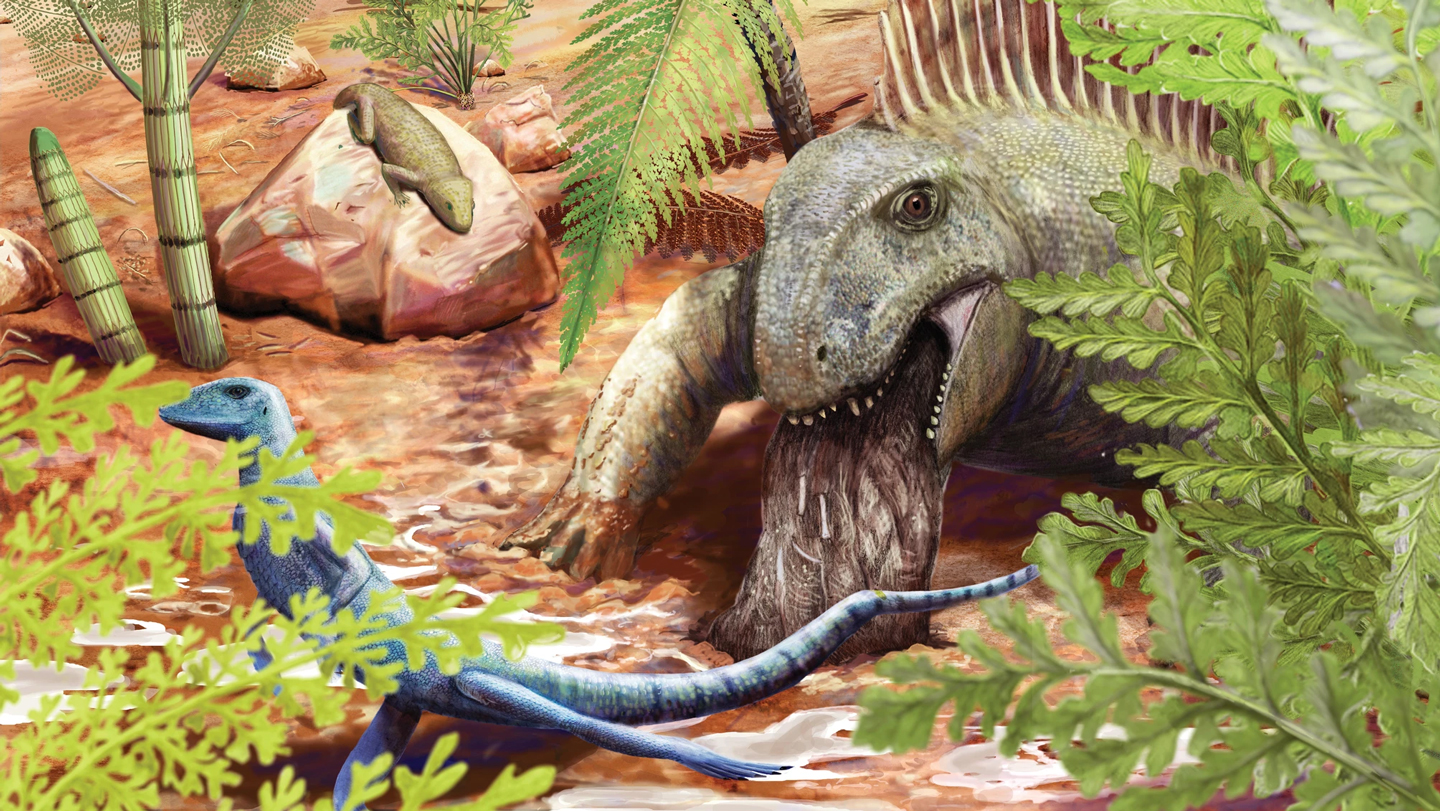
Fossilized vomit reveals 290-million-year-old predator’s diet Skip to content Subscribe today Every print subscription comes with full digital access Subscribe Now Menu All Topics Health Humans Anthropology Health & Medicine Archaeology Psychology View All Life Animals Plants Ecosystems Paleontology Neuroscience Genetics Microbes View All Earth Agriculture Climate Oceans Environment View All Physics Materials Science Quantum Physics Particle Physics View All Space Astronomy Planetary Science Cosmology View All Magazine Menu All Stories Multimedia Reviews Puzzles Collections Educator Portal Century of Science Unsung characters Coronavirus Outbreak Newsletters Investors Lab About SN Explores Our Store SIGN IN Donate Home INDEPENDENT JOURNALISM SINCE 1921 SIGN IN Search Open search Close search Home INDEPENDENT JOURNALISM SINCE 1921 All Topics Earth Agriculture Climate Oceans Environment Humans Anthropology Health & Medicine Archaeology Psychology Life Animals Plants Ecosystems Paleontology Neuroscience Genetics Microbes Physics Materials Science Quantum Physics Particle Physics Space Astronomy Planetary Science Cosmology Tech Computing Artificial Intelligence Chemistry Math Science & Society All Topics Health Humans Humans Anthropology Health & Medicine Archaeology Psychology Recent posts in Humans Health & Medicine A simple shift in schedule could make cancer immunotherapy work better By Elie DolginFebruary 12, 2026 Health & Medicine This baby sling turns sunlight into treatment for newborn jaundice By Elie DolginFebruary 12, 2026 Health & Medicine Antibiotics can treat appendicitis for many patients, no surgery needed By Laura DattaroFebruary 10, 2026 Life Life Animals Plants Ecosystems Paleontology Neuroscience Genetics Microbes Recent posts in Life Oceans Evolution didn’t wait long after the dinosaurs died By Elie Dolgin2 hours ago Animals A sea turtle boom may be hiding a population collapse By Melissa Hobson4 hours ago Ecosystems Food chains in Caribbean coral reefs are getting shorter By Erin Garcia de JesúsFebruary 11, 2026 Earth Earth Agriculture Climate Oceans Environment Recent posts in Earth Oceans Evolution didn’t wait long after the dinosaurs died By Elie Dolgin2 hours ago Earth Earth’s core may hide dozens of oceans of hydrogen By Nikk OgasaFebruary 10, 2026 Animals Some dung beetles dig deep to keep their eggs cool By Elizabeth PennisiFebruary 4, 2026 Physics Physics Materials Science Quantum Physics Particle Physics Recent posts in Physics Physics A precise proton measurement helps put a core theory of physics to the test By Emily ConoverFebruary 11, 2026 Physics The only U.S. particle collider shuts down – so a new one may rise By Emily ConoverFebruary 6, 2026 Physics A Greek star catalog from the dawn of astronomy, revealed By Adam MannJanuary 30, 2026 Space Space Astronomy Planetary Science Cosmology Recent posts in Space Astronomy This inside-out planetary system has astronomers scratching their heads By Adam MannFebruary 12, 2026 Space Artemis II is returning humans to the moon with science riding shotgun By Lisa GrossmanFebruary 4, 2026 Physics A Greek star catalog from the dawn of astronomy, revealed By Adam MannJanuary 30, 2026 News Paleontology Fossilized vomit reveals 290-million-year-old predator’s diet Regurgitated material contains the prey of a hunter that lived before the dinosaurs This illustration depicts the early Permian apex predator Dimetrodon teutonis regurgitating the remains of prey animals. Two smaller prey animals identified in the fossil vomit, Eudibamus cursoris (forground) and Thuringothyris mahlendorffae (backround), are also depicted. Sophie Fernandez By Jay Bennett February 11, 2026 at 9:00 am Share this:Share Share via email (Opens in new window) Email Click to share on Facebook (Opens in new window) Facebook Click to share on Reddit (Opens in new window) Reddit Click to share on X (Opens in new window) X Click to print (Opens in new window) Print Two hundred and ninety million years ago, in a mountain valley within the central region of the supercontinent Pangaea, an apex predator snapped up at least three other animals and sometime later puked up the bones. That material hardened over the ages, and is now the oldest fossilized vomit ever discovered from a land-based ecosystem. The cluster of bones and digestive material provides rare information, published January 30 in Scientific Reports, about the behavior of some of the world’s earliest land predators. Sign up for our newsletter We summarize the week's scientific breakthroughs every Thursday. “It’s kind of like a photograph of a moment in the past that is telling us about the animal that was living,” says Arnaud Rebillard, a paleontologist at Museum für Naturkunde in Berlin. “Any data that we can find about their behavior is very precious.” Paleontologists discovered the lime-sized specimen in 2021 at a site called the Bromacker locality in central Germany. Researchers then scanned the bones to create 3-D models showing a cluster of parts from different animals, suggesting they had come from a predator’s gut. They also chemically analyzed the material surrounding the bones and found that it was low in phosphorus, suggesting it was not a fossilized dropping. This shows a photo of the complete specimen of fossilized vomit (top left), as well as a computer scan of the specimen highlighting its cluster of 41 bones (bottom left) and scans of the subset of 25 bones that the team could attribute to prey species (right). Arnaud RebillardThis shows a photo of the complete specimen of fossilized vomit (top left), as well as a computer scan of the specimen highlighting its cluster of 41 bones (bottom left) and scans of the subset of 25 bones that the team could attribute to prey species (right). Arnaud Rebillard While the specific predator that regurgitated the bones is unknown, the researchers strongly suspect that it was one of two animals that resemble today’s monitor lizards like Komodo dragons: Dimetrodon teutonis, with a prominent sail on its back, and Tambacarnifex unguifalcatus. Though reptilian in appearance, both are from a group of animals called synapsids that includes mammals and their extinct relatives. Among the 41 disgorged bones, the researchers were able to distinguish two small lizardlike reptiles and a limb bone from a larger reptilelike herbivore. This collection of remains, along with several unidentified bones, indicates that the predator ate whatever it could find rather than specializing in a specific type of prey. Because the fossilized vomit, or regurgitalite, contains three different animals eaten by one predator, “we can literally say, for sure, that these three animals were living at exactly the same place and exactly the same time, maybe to the week or even to the day,” Rebillard says. Several living predators habitually regurgitate bones and other body parts that are tough to
Fossilized vomit reveals 290-million-year-old predator’s diet