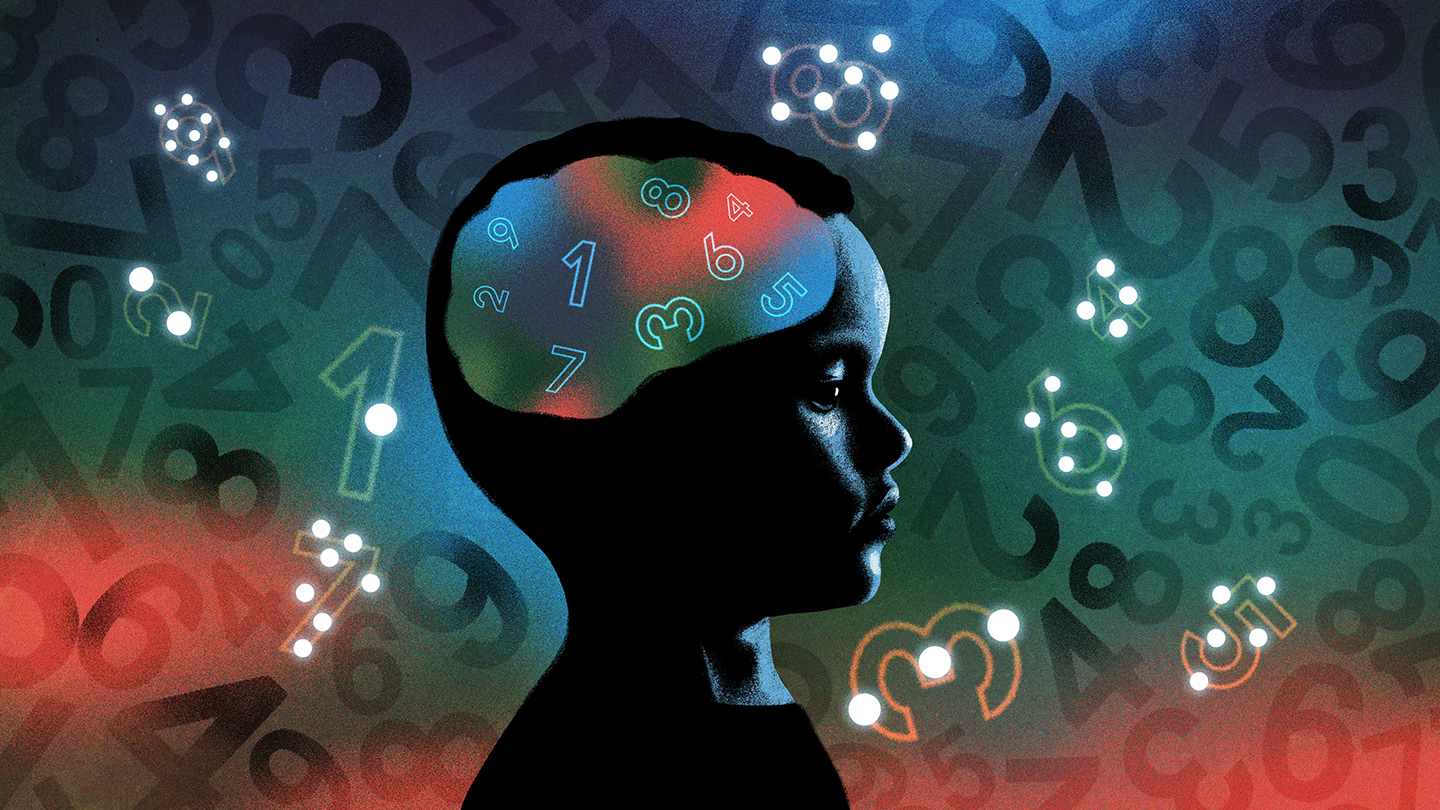
Why is math is harder for some kids? Brain scans offer clues Skip to content Subscribe today Every print subscription comes with full digital access Subscribe Now Menu All Topics Health Humans Anthropology Health & Medicine Archaeology Psychology View All Life Animals Plants Ecosystems Paleontology Neuroscience Genetics Microbes View All Earth Agriculture Climate Oceans Environment View All Physics Materials Science Quantum Physics Particle Physics View All Space Astronomy Planetary Science Cosmology View All Magazine Menu All Stories Multimedia Reviews Puzzles Collections Educator Portal Century of Science Unsung characters Coronavirus Outbreak Newsletters Investors Lab About SN Explores Our Store SIGN IN Donate Home INDEPENDENT JOURNALISM SINCE 1921 SIGN IN Search Open search Close search Home INDEPENDENT JOURNALISM SINCE 1921 All Topics Earth Agriculture Climate Oceans Environment Humans Anthropology Health & Medicine Archaeology Psychology Life Animals Plants Ecosystems Paleontology Neuroscience Genetics Microbes Physics Materials Science Quantum Physics Particle Physics Space Astronomy Planetary Science Cosmology Tech Computing Artificial Intelligence Chemistry Math Science & Society All Topics Health Humans Humans Anthropology Health & Medicine Archaeology Psychology Recent posts in Humans Neuroscience Why is math harder for some kids? Brain scans offer clues By Lily Burton8 hours ago Health & Medicine Can you trust the results from gut microbiome tests? Maybe not By Tina Hesman SaeyFebruary 26, 2026 Anthropology Mosquitoes began biting humans more than a million years ago By Tom MetcalfeFebruary 26, 2026 Life Life Animals Plants Ecosystems Paleontology Neuroscience Genetics Microbes Recent posts in Life Neuroscience Why is math harder for some kids? Brain scans offer clues By Lily Burton8 hours ago Animals Here’s how honeyeaters and other birds thrive on sugary diets By Bethany BrookshireFebruary 26, 2026 Anthropology Mosquitoes began biting humans more than a million years ago By Tom MetcalfeFebruary 26, 2026 Earth Earth Agriculture Climate Oceans Environment Recent posts in Earth Climate Take it from the Olympics, slushy winter sports may be the new normal By Natasha Vizcarra6 hours ago Animals Climate change could threaten monarch mass migration By Erin Garcia de JesúsFebruary 25, 2026 Earth Metal pollution from a rocket reentry detected for the first time By Adam MannFebruary 25, 2026 Physics Physics Materials Science Quantum Physics Particle Physics Recent posts in Physics Physics Here’s why sneakers squeak on the basketball court By Emily ConoverFebruary 25, 2026 Animals Intricate silk helps net-casting spiders ensnare prey in webs By Emily ConoverFebruary 24, 2026 Physics Physicists dream up ‘spacetime quasicrystals’ that could underpin the universe By Emily ConoverFebruary 17, 2026 Space Space Astronomy Planetary Science Cosmology Recent posts in Space Space NASA scraps its 2027 moon landing, adds two missions in 2028 By Lisa Grossman5 hours ago Science & Society On moonshots and Minneapolis By Lisa Grossman10 hours ago Earth Metal pollution from a rocket reentry detected for the first time By Adam MannFebruary 25, 2026 Neuroscience Why is math harder for some kids? Brain scans offer clues MRIs show different brain activity patterns for kids with math learning disabilities When kids with math learning disabilities solve a math problem with number symbols, they approach and process it differently than typical kids. But differences disappear when numbers are shown as dots. Matt Chinworth By Lily Burton 8 hours ago Share this:Share Share via email (Opens in new window) Email Share on Facebook (Opens in new window) Facebook Share on Reddit (Opens in new window) Reddit Share on X (Opens in new window) X Print (Opens in new window) Print Some kids struggle with math. Now, scientists have pinpointed some of the specific thinking processes and brain regions that might explain why math is a little harder for some than others. When given simple math problems, kids with math learning disabilities in a new study were less cautious about giving their answers and did not slow down after making errors compared with kids with typical math skills. But these differences disappeared when those same kids were given problems with dots to represent numbers instead of Arabic number symbols, researchers report February 9 in the Journal of Neuroscience. Sign up for our newsletter We summarize the week's scientific breakthroughs every Thursday. The idea that number symbols can be a challenge is not new. “There’s a very consistent observation that it’s the symbolic processing that is really the struggle for children with difficulties,” says Bert De Smedt, an educational neuroscientist at KU Leuven in Belgium who was not involved in the study. But the subtle differences in how kids with math learning disabilities approach problems, like not answering cautiously and not slowing down after errors, advance understanding of what underlies their difficulties with number symbols, he says. In the new study, researchers tested second- and third-grade kids with and without math learning disabilities by showing them two numbers from 1 to 9 and giving the kids a few seconds to pick which number they thought was larger. The researchers recorded how long it took kids to answer questions and observed kids’ brain activities using an MRI scanner. The team analyzed the data about the kids’ performance and behavior during the test using a complex mathematical analysis designed to find subtle patterns in behavior, like how carefully children answered throughout the experiment and how they changed their behavior after mistakes. They then compared those behavior patterns with brain activity. “We weren’t necessarily interested in the performance of this task but how they may approach this task differently between the two groups of children,” says Hyesang Chang, a cognitive neuroscientist at San José State University in California, who did the research while at Stanford University. From the MRI data, Chang and colleagues found that the lack of caution in kids with math learning disabilities when giving answers was associated with lower activity in the middle frontal gyrus, a brain region associated with processing numbers as well as focus, impulse control and adapting to changing circumstances. Meanwhile, not slowing down after errors was associated with lower activity in the anterior cingulate cortex, a brain region involved in detecting errors and monitoring performance. When kids were given similar problems with dots instead of numbers, those differences went away. Children with math learning disabilities had the same amount of activity in the two identified brain areas as kids without those disabilities. Chang notes, however, that the analysis is exploratory and cannot show cause and effect between brain activity in these regions an
Why is math harder for some kids? Brain scans offer clues