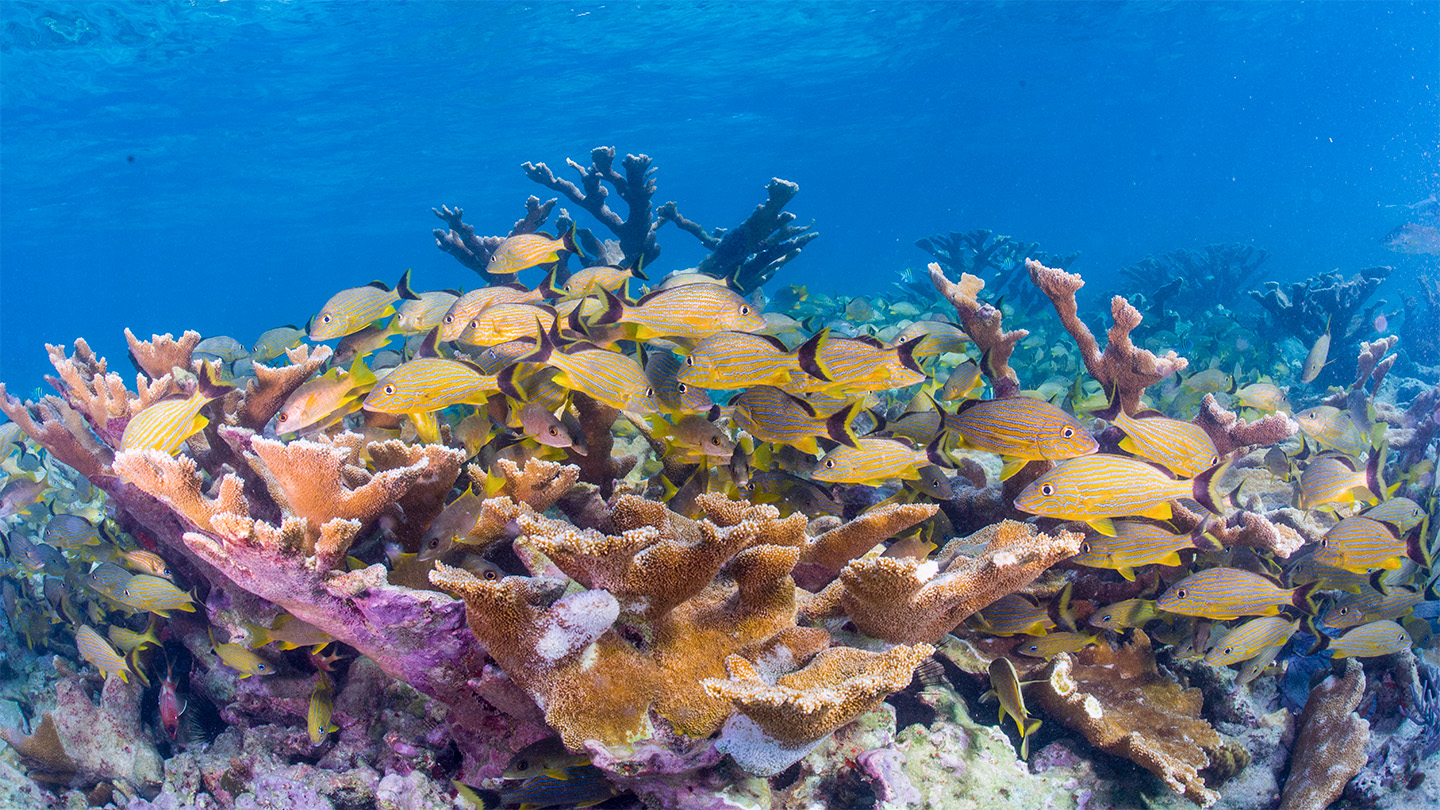
Food chains in Caribbean coral reefs are getting shorter Skip to content Subscribe today Every print subscription comes with full digital access Subscribe Now Menu All Topics Health Humans Anthropology Health & Medicine Archaeology Psychology View All Life Animals Plants Ecosystems Paleontology Neuroscience Genetics Microbes View All Earth Agriculture Climate Oceans Environment View All Physics Materials Science Quantum Physics Particle Physics View All Space Astronomy Planetary Science Cosmology View All Magazine Menu All Stories Multimedia Reviews Puzzles Collections Educator Portal Century of Science Unsung characters Coronavirus Outbreak Newsletters Investors Lab About SN Explores Our Store SIGN IN Donate Home INDEPENDENT JOURNALISM SINCE 1921 SIGN IN Search Open search Close search Home INDEPENDENT JOURNALISM SINCE 1921 All Topics Earth Agriculture Climate Oceans Environment Humans Anthropology Health & Medicine Archaeology Psychology Life Animals Plants Ecosystems Paleontology Neuroscience Genetics Microbes Physics Materials Science Quantum Physics Particle Physics Space Astronomy Planetary Science Cosmology Tech Computing Artificial Intelligence Chemistry Math Science & Society All Topics Health Humans Humans Anthropology Health & Medicine Archaeology Psychology Recent posts in Humans Health & Medicine A simple shift in schedule could make cancer immunotherapy work better By Elie DolginFebruary 12, 2026 Health & Medicine This baby sling turns sunlight into treatment for newborn jaundice By Elie DolginFebruary 12, 2026 Health & Medicine Antibiotics can treat appendicitis for many patients, no surgery needed By Laura DattaroFebruary 10, 2026 Life Life Animals Plants Ecosystems Paleontology Neuroscience Genetics Microbes Recent posts in Life Oceans Evolution didn’t wait long after the dinosaurs died By Elie Dolgin3 hours ago Animals A sea turtle boom may be hiding a population collapse By Melissa Hobson5 hours ago Ecosystems Food chains in Caribbean coral reefs are getting shorter By Erin Garcia de JesúsFebruary 11, 2026 Earth Earth Agriculture Climate Oceans Environment Recent posts in Earth Oceans Evolution didn’t wait long after the dinosaurs died By Elie Dolgin3 hours ago Earth Earth’s core may hide dozens of oceans of hydrogen By Nikk OgasaFebruary 10, 2026 Animals Some dung beetles dig deep to keep their eggs cool By Elizabeth PennisiFebruary 4, 2026 Physics Physics Materials Science Quantum Physics Particle Physics Recent posts in Physics Physics A precise proton measurement helps put a core theory of physics to the test By Emily ConoverFebruary 11, 2026 Physics The only U.S. particle collider shuts down – so a new one may rise By Emily ConoverFebruary 6, 2026 Physics A Greek star catalog from the dawn of astronomy, revealed By Adam MannJanuary 30, 2026 Space Space Astronomy Planetary Science Cosmology Recent posts in Space Astronomy This inside-out planetary system has astronomers scratching their heads By Adam MannFebruary 12, 2026 Space Artemis II is returning humans to the moon with science riding shotgun By Lisa GrossmanFebruary 4, 2026 Physics A Greek star catalog from the dawn of astronomy, revealed By Adam MannJanuary 30, 2026 News Ecosystems Food chains in Caribbean coral reefs are getting shorter Fish on modern coral reefs may face more competition for resources than 7,000 years ago A school of blue-striped grunts (Haemulon sciurus) swim around elkhorn coral (Acropora palmata) in the Caribbean. Modern coral reef food chains are shorter than they were roughly 7,000 years ago, a new study suggests. Michael Aw/Ocean Image Bank By Erin Garcia de Jesús February 11, 2026 at 11:52 am Share this:Share Share via email (Opens in new window) Email Click to share on Facebook (Opens in new window) Facebook Click to share on Reddit (Opens in new window) Reddit Click to share on X (Opens in new window) X Click to print (Opens in new window) Print Listen to this article This is a human-written story voiced by AI. Got feedback? Take our survey . (See our AI policy here .) Some ancient fish in the Caribbean may have lost their lunch. Modern food chains on coral reefs off the coasts of the Dominican Republic and Panama are roughly 60 to 70 percent shorter than they were around 7,000 years ago, researchers report February 11 in Nature. Habitat loss and overfishing may have pushed more species to compete for fewer resources and repositioned some fish groups within the ecosystem’s food chain. The findings suggest fish could be less able to adapt if food sources suddenly become scarce, perhaps making today’s reefs even more vulnerable in an already changing environment. Sign up for our newsletter We summarize the week's scientific breakthroughs every Thursday. “Understanding the food webs helps us understand the health of the reef,” says Jessica Lueders-Dumont, a fisheries ecologist and geochemist at Boston College in Chestnut Hill, Mass. “If we could go back, scuba dive on the same reefs a couple thousand years ago, what would they look like?” Rather than time travel, Lueders-Dumont and colleagues examined fossilized and modern fish ear stones called otoliths that are important for movement and hearing. Otolith shape depends on species, and the team measured the amount of a heavy form of nitrogen to determine which critters were lower or higher in the food chain. Animals higher in the food chain, like sharks, have higher ratios of heavy nitrogen over a lighter form. Prey have a lower ratio. Ear stones called otoliths are calcium carbonate structures in the ear that help vertebrates move and hear. Because shape varies, researchers can use the structures to identify animal groups and, in some cases, species. Shown clockwise from the left are fish otoliths from a grunt (Haemulon), bridled goby (Coryphopterus glaucofraenum), hardhead silverside (Atherinomorus stipes) and barred cardinalfish (Apogon binotatus).Chien-Hsiang Lin While modern fish seem to be competing for similar food sources, many prehistoric reef fish had highly specialized diets, Lueders-Dumont says. “If you were a goby on a reef 7,000 years ago, you had your favorite little amphipod that you would eat, and that amphipod population was on this one little coral that you had access to.” But today’s reefs have lost diversity at both the top and the bottom of the food chain. If a goby’s coral went extinct and there were fewer predators lurking around, the goby’s descendants might forage widely for food. But more species may then compete for the same resources, which could spell trouble. It’s as if neighborhoods replaced locally owned restaurants that serve a variety of foods with national chains that offer similar menus, Lueders-Dumont says. With fewer options available, “if the supply chain [for] beef or something gets messed up, then everybody is affected.” But there are signs of hope. In Panama, where officia
Food chains in Caribbean coral reefs are getting shorter