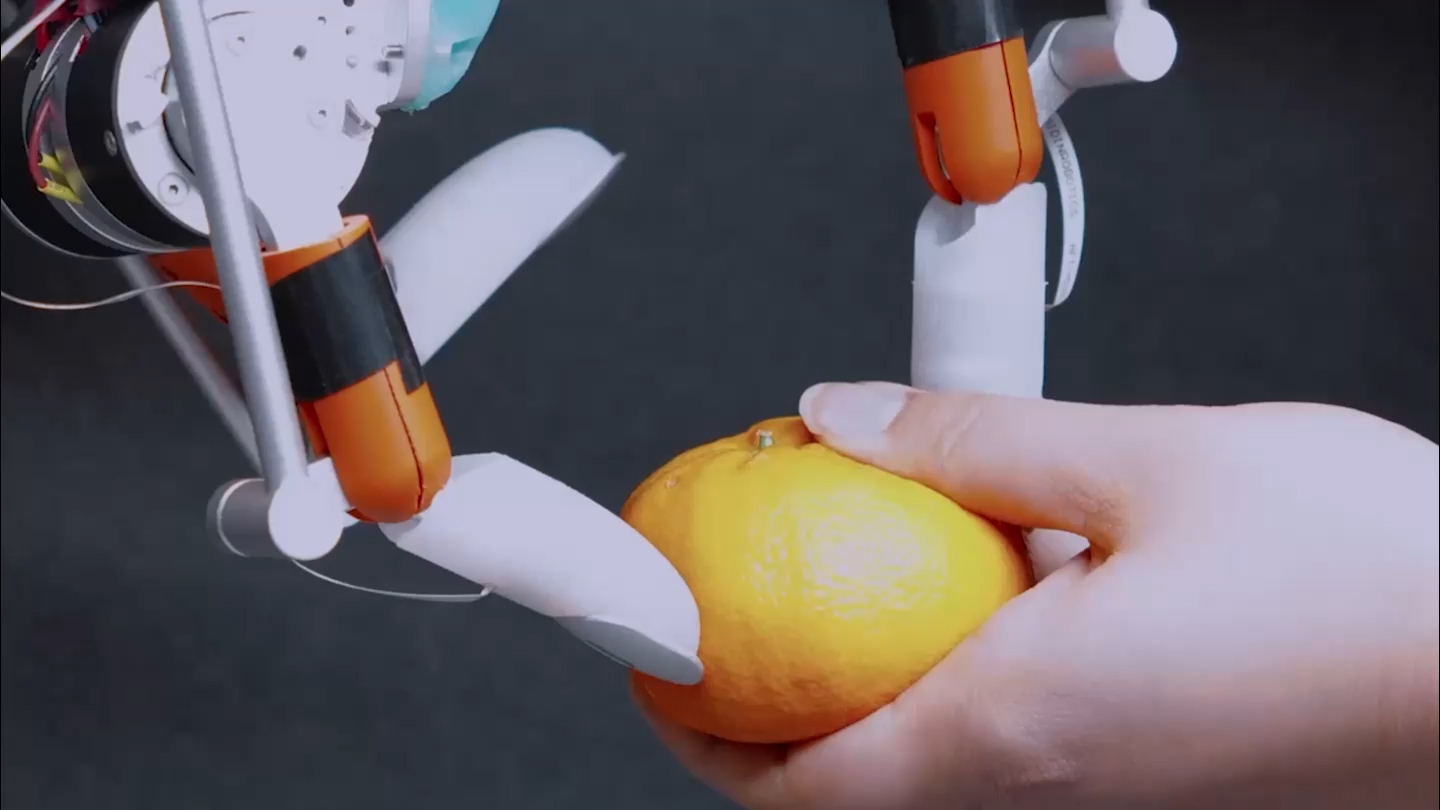
Robots with fingernails can grasp thin edges Skip to content Subscribe today Every print subscription comes with full digital access Subscribe Now Menu All Topics Health Humans Anthropology Health & Medicine Archaeology Psychology View All Life Animals Plants Ecosystems Paleontology Neuroscience Genetics Microbes View All Earth Agriculture Climate Oceans Environment View All Physics Materials Science Quantum Physics Particle Physics View All Space Astronomy Planetary Science Cosmology View All Magazine Menu All Stories Multimedia Reviews Puzzles Collections Educator Portal Century of Science Unsung characters Coronavirus Outbreak Newsletters Investors Lab About SN Explores Our Store SIGN IN Donate Home INDEPENDENT JOURNALISM SINCE 1921 SIGN IN Search Open search Close search Home INDEPENDENT JOURNALISM SINCE 1921 All Topics Earth Agriculture Climate Oceans Environment Humans Anthropology Health & Medicine Archaeology Psychology Life Animals Plants Ecosystems Paleontology Neuroscience Genetics Microbes Physics Materials Science Quantum Physics Particle Physics Space Astronomy Planetary Science Cosmology Tech Computing Artificial Intelligence Chemistry Math Science & Society All Topics Health Humans Humans Anthropology Health & Medicine Archaeology Psychology Recent posts in Humans Neuroscience The right sounds may turn sleep into a problem-solving tool By Bethany BrookshireMarch 3, 2026 Health & Medicine Over 40? Your rotator cuff probably looks a little rough By Meghan RosenMarch 3, 2026 Health & Medicine Simulations of your gut may predict which probiotics will stick By Nora BradfordMarch 2, 2026 Life Life Animals Plants Ecosystems Paleontology Neuroscience Genetics Microbes Recent posts in Life Neuroscience The remarkable brains of ‘SuperAgers’ hold clues about how we age By Laura Sanders6 hours ago Animals A koala population’s rapid rebound may let it escape inbreeding’s perils By Jake BuehlerMarch 5, 2026 Plants Chickpeas can grow in moon dirt and make seeds By Lisa GrossmanMarch 5, 2026 Earth Earth Agriculture Climate Oceans Environment Recent posts in Earth Climate Hundreds of studies have missed how much the oceans are rising By Nikk OgasaMarch 4, 2026 Climate Take it from the Olympics, slushy winter sports may be the new normal By Natasha VizcarraFebruary 27, 2026 Animals Climate change could threaten monarch mass migration By Erin Garcia de JesúsFebruary 25, 2026 Physics Physics Materials Science Quantum Physics Particle Physics Recent posts in Physics Chemistry This molecule puts a new twist on the Möbius strip By Emily ConoverMarch 5, 2026 Physics Here’s why sneakers squeak on the basketball court By Emily ConoverFebruary 25, 2026 Animals Intricate silk helps net-casting spiders ensnare prey in webs By Emily ConoverFebruary 24, 2026 Space Space Astronomy Planetary Science Cosmology Recent posts in Space Planetary Science NASA’s DART spacecraft changed an asteroid’s orbit around the sun By Lisa Grossman3 hours ago Plants Chickpeas can grow in moon dirt and make seeds By Lisa GrossmanMarch 5, 2026 Planetary Science A Titan collision may link Saturn’s tilt, its moon Hyperion and its rings By Lisa GrossmanMarch 4, 2026 News Tech Robots with fingernails can grasp thin edges A new three-fingered hand peels fruit, flips cards and lifts coins off flat surfaces ⏸ The three-fingered hand peels an orange using the rigid nails to grasp and puncture the fruit’s skin. The nails can also pop the top of a thin lid. D.H. Kang et al/arXiv, 2026 By Ananya 8 hours ago Share this:Share Share via email (Opens in new window) Email Share on Facebook (Opens in new window) Facebook Share on Reddit (Opens in new window) Reddit Share on X (Opens in new window) X Print (Opens in new window) Print Robotic hands are getting their nails done. Researchers have designed a new three-fingered robotic hand whose digits come with a rigid fingernail on soft material. The design gives the robotic hand the ability to peel fruit, open containers with lids and pick up flat objects, the team posted to arXiv.org February 5. The results offer a glimpse at the kinds of real‑world chores and industrial handling tasks the robot could do. The tips of most conventional robotic hands have a soft pad on a rigid structure, giving the fingertip a squarish shape. The new robot fingertips have a soft material wrapped around the finger “skeleton,” with a rigid structure on top, giving the tip an oval shape, more like our fingers. “A square shape only adapts well to forces coming straight on, but our design can also respond flexibly to twisting or side forces,” says mechanical engineer Dong Ho Kang of the University of Texas at Austin. Sign up for our newsletter We summarize the week's scientific breakthroughs every Thursday. Soft fingertips with that square design adapt to objects and grasp them, but that same softness makes them less precise. In humans, rigid fingernails on soft fingertips correct this issue by stiffening the fingertips and focusing pressure. A new three-fingered robotic hand sports rigid fingernails on soft, flexible fingers. The fingernails help the robotic hand peel fruit, open containers with lids and even pick up thin, flat objects that are usually difficult for robots to handle. Taking inspiration from our own nails, the researchers tested robotic hands with three linked, motorized fingers — index and middle fingers and a thumb — with and without nails. The fingers grasped flat, outward-bulging and inward-curved objects, while the objects were being pulled upward. The fingertips with nails demonstrated a stronger grasping force, meaning they had a tighter grip, Kang says. Fingernails were an advantage when grabbing curved objects. Without them, the soft fingers were easily deformed and had a less stable hold on the objects. Fingertips with nails also excelled at pulling out a single sheet from a stack of papers, opening the lid of a sealed container, picking up thin objects like coins and cards from a surface, and flipping cards. Although they were able to open the lid on some attempts, the soft fingertips without the nails failed at all other tasks and were unable to establish contact with the edges of the objects. Kang says the next step is to extend this work to a full robotic hand. Questions or comments on this article? E-mail us at feedback@sciencenews.org | Reprints FAQ Citations D.H. Kang et al. PLATO Hand: Shaping contact behavior with fingernails for precise manipulation. arXiv:2602.05156. Posted February 5, 2026. About Ananya Ananya is a freelance science writer, journalist and translator, with a research background in robotics. She covers all things algorithms, robots, animals, oceans, urban and the people involved in these fields. We are at a critical time and supporting science journalism is more important than ever. Science News and our parent organization, the Society for Science, need your help
Robots with fingernails can grasp thin edges