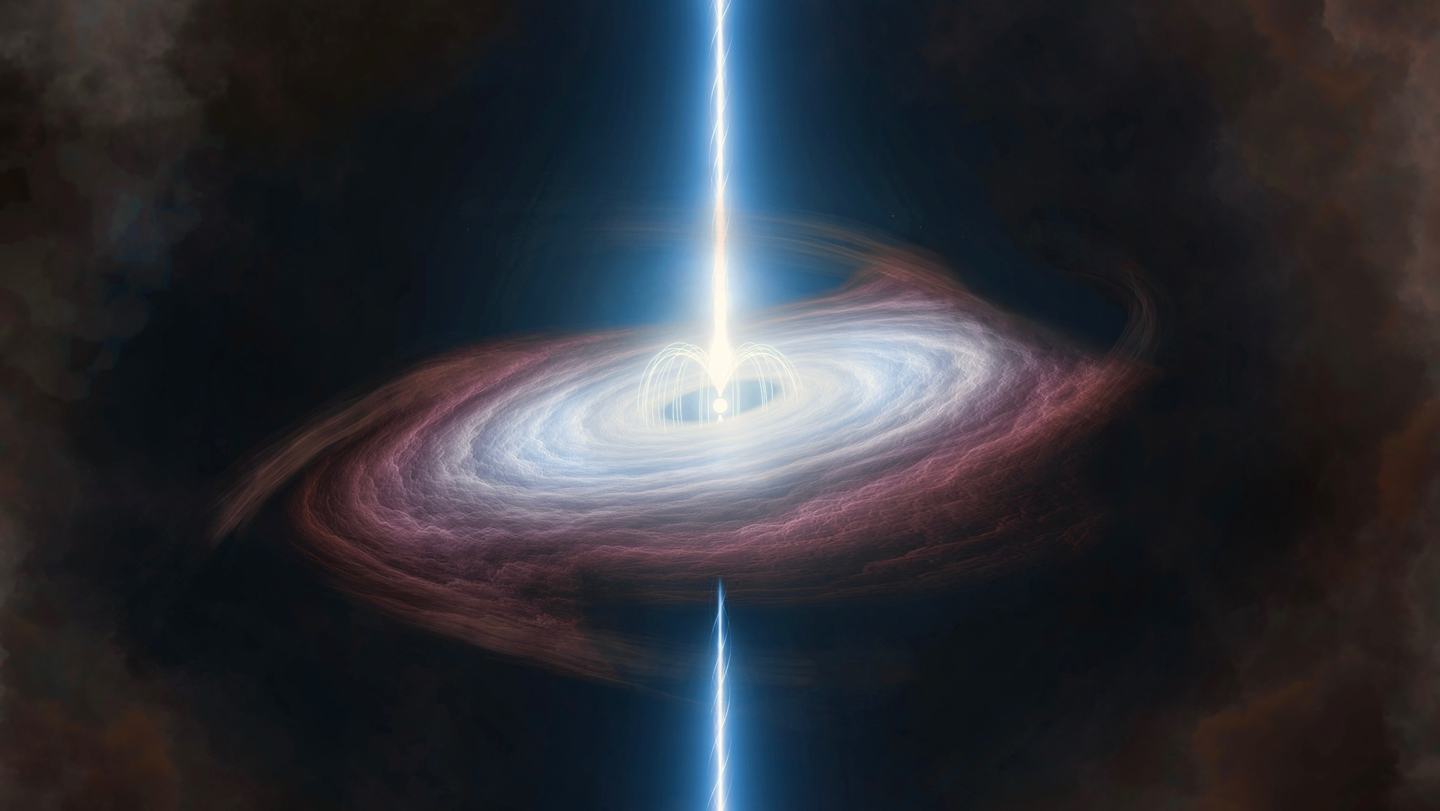
A strange ‘chirp’ in a brilliant stellar blast points to a magnetar Skip to content Subscribe today Every print subscription comes with full digital access Subscribe Now Menu All Topics Health Humans Anthropology Health & Medicine Archaeology Psychology View All Life Animals Plants Ecosystems Paleontology Neuroscience Genetics Microbes View All Earth Agriculture Climate Oceans Environment View All Physics Materials Science Quantum Physics Particle Physics View All Space Astronomy Planetary Science Cosmology View All Magazine Menu All Stories Multimedia Reviews Puzzles Collections Educator Portal Century of Science Unsung characters Coronavirus Outbreak Newsletters Investors Lab About SN Explores Our Store SIGN IN Donate Home INDEPENDENT JOURNALISM SINCE 1921 SIGN IN Search Open search Close search Home INDEPENDENT JOURNALISM SINCE 1921 All Topics Earth Agriculture Climate Oceans Environment Humans Anthropology Health & Medicine Archaeology Psychology Life Animals Plants Ecosystems Paleontology Neuroscience Genetics Microbes Physics Materials Science Quantum Physics Particle Physics Space Astronomy Planetary Science Cosmology Tech Computing Artificial Intelligence Chemistry Math Science & Society All Topics Health Humans Humans Anthropology Health & Medicine Archaeology Psychology Recent posts in Humans Health & Medicine ‘Smart underwear’ measures how often humans fart By Tina Hesman SaeyMarch 10, 2026 Health & Medicine How does early pregnancy lower breast cancer risk? Odd cells could offer clues By Meghan RosenMarch 9, 2026 Neuroscience The right sounds may turn sleep into a problem-solving tool By Bethany BrookshireMarch 3, 2026 Life Life Animals Plants Ecosystems Paleontology Neuroscience Genetics Microbes Recent posts in Life Genetics The Amazon molly — a sex-skipping fish — hacks evolution By Elie Dolgin5 minutes ago Animals Submerged bumblebee queens breathe underwater By Erin Garcia de Jesús16 hours ago Plants Tree tops sparkle with electricity during thunderstorms By Lily BurtonMarch 10, 2026 Earth Earth Agriculture Climate Oceans Environment Recent posts in Earth Plants Tree tops sparkle with electricity during thunderstorms By Lily BurtonMarch 10, 2026 Climate Lakes are growing in Alaska. That’s not entirely a bad thing By Douglas FoxMarch 9, 2026 Climate Hundreds of studies have missed how much the oceans are rising By Nikk OgasaMarch 4, 2026 Physics Physics Materials Science Quantum Physics Particle Physics Recent posts in Physics Plants Tree tops sparkle with electricity during thunderstorms By Lily BurtonMarch 10, 2026 Physics When the pressure’s off, this superconductor appears to break records By Emily ConoverMarch 9, 2026 Chemistry This molecule puts a new twist on the Möbius strip By Emily ConoverMarch 5, 2026 Space Space Astronomy Planetary Science Cosmology Recent posts in Space Planetary Science NASA’s DART spacecraft changed an asteroid’s orbit around the sun By Lisa GrossmanMarch 6, 2026 Plants Chickpeas can grow in moon dirt and make seeds By Lisa GrossmanMarch 5, 2026 Planetary Science A Titan collision may link Saturn’s tilt, its moon Hyperion and its rings By Lisa GrossmanMarch 4, 2026 Astronomy A strange ‘chirp’ in a brilliant stellar blast points to a magnetar The unusual supernova signal may reveal what powers the universe’s brightest blasts An extreme star called a magnetar, surrounded by a wobbling accretion disk (illustrated), may have created a never-before-seen signal recently detected by astronomers. Joseph Farah and Curtis McCully By Jay Bennett 5 minutes ago Share this:Share Share via email (Opens in new window) Email Share on Facebook (Opens in new window) Facebook Share on Reddit (Opens in new window) Reddit Share on X (Opens in new window) X Print (Opens in new window) Print About a billion light-years away, an extraordinary stellar explosion lit up in the night sky. The blast, detected December 12, 2024, was some 30 times the brightness of a typical supernova, putting it in a rare group of superluminous supernovas. Now, astronomers believe they know what made the explosion so bright — an extreme type of star called a magnetar, the team reports March 11 in Nature. “Superluminous supernovae are 10 to 100 times brighter than regular supernovae,” says astrophysicist Joseph Farah of the University of California, Santa Barbara. Sign up for our newsletter We summarize the week's scientific breakthroughs every Thursday. What makes the new superluminous supernova unique is that it appears to contain a distinct signal that scientists call a “chirp.” This is not a sound we can hear, but instead a signal astronomers can see. The chirp is a brightness fluctuation whose frequency increases over time, meaning the supernova’s light brightens and dims in cycles that come faster and faster. “No supernova has had a chirp before, so there has to be something weird going on,” Farah says. He was part of a team that studied the supernova with a global network of telescopes called the Las Cumbres Observatory. The team then ran computer simulations of the explosion’s light. The results suggested the supernova’s extreme light show was driven by a dense, highly magnetized object called a magnetar. When the core of a star collapses and triggers a supernova, it usually leaves behind a black hole or a dense neutron star. Magnetars are neutron stars with extreme magnetic fields. Farah says a magnetar is the only strong explanation for the chirp in the 2024 supernova, supporting prior ideas that rotating magnetars can power these superluminous events. “To see something brand new, and then to make a prediction as it’s happening, and then that prediction comes true — it’s like you just had a conversation with the universe,” he says. Finding additional superluminous supernovas with a chirp signal would help confirm the team’s findings. “I don’t think it’s the final smoking gun yet,” says astrophysicist Matt Nicholl of Queen’s University Belfast in Northern Ireland. “It’s very hard to explain a chirp any other way. It’s really just about confirming we are definitely seeing a chirp,” he says. “This is certainly the most convincing one that’s out there, but I just would like to see a few more before I declare it is indeed proof of the magnetar.” If a magnetar did drive the 2024 event, scientists would still need to explain exactly how. Farah and colleagues suggest a disk of gas and dust from the exploded star formed around the magnetar during the supernova. This disk would have wobbled due to extreme gravitational effects, blocking or redirecting varying amounts of light at different times. As the wobbling sped up, it could have produced the chirp in the supernova’s light signal. “The best way to imagine it is, if you were an observer trying to sit still around the magnetar, it would be really, really hard becaus
A strange ‘chirp’ in a brilliant stellar blast points to a magnetar