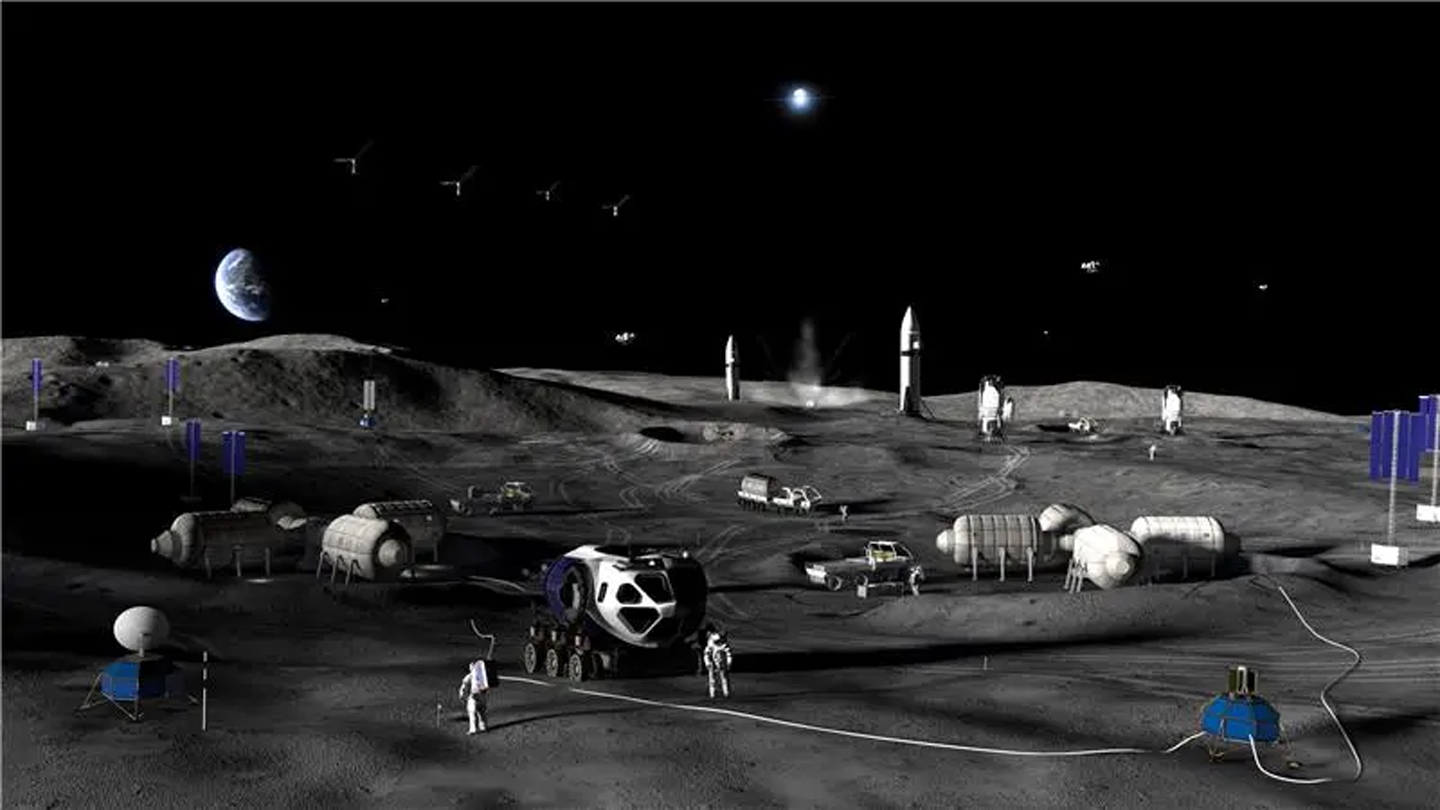
NASA races to have the first moon base and nuclear-propulsion spacecraft Skip to content Subscribe today Every print subscription comes with full digital access Subscribe Now Menu All Topics Health Humans Anthropology Health & Medicine Archaeology Psychology View All Life Animals Plants Ecosystems Paleontology Neuroscience Genetics Microbes View All Earth Agriculture Climate Oceans Environment View All Physics Materials Science Quantum Physics Particle Physics View All Space Astronomy Planetary Science Cosmology View All Magazine Menu All Stories Multimedia Reviews Puzzles Collections Educator Portal Century of Science Unsung characters Coronavirus Outbreak Newsletters Investors Lab About SN Explores Our Store SIGN IN Donate Home INDEPENDENT JOURNALISM SINCE 1921 SIGN IN Search Open search Close search Home INDEPENDENT JOURNALISM SINCE 1921 All Topics Earth Agriculture Climate Oceans Environment Humans Anthropology Health & Medicine Archaeology Psychology Life Animals Plants Ecosystems Paleontology Neuroscience Genetics Microbes Physics Materials Science Quantum Physics Particle Physics Space Astronomy Planetary Science Cosmology Tech Computing Artificial Intelligence Chemistry Math Science & Society All Topics Health Humans Humans Anthropology Health & Medicine Archaeology Psychology Recent posts in Humans Animals When were dogs domesticated? The oldest known dog DNA offers clues By Tom Metcalfe7 hours ago Archaeology Neandertals made antibacterial ointment, but may not have known it By Martin J. KernanMarch 24, 2026 Health & Medicine Amid vaccine policy whiplash, here’s how a pediatrician talks to families By Aimee CunninghamMarch 20, 2026 Life Life Animals Plants Ecosystems Paleontology Neuroscience Genetics Microbes Recent posts in Life Animals When were dogs domesticated? The oldest known dog DNA offers clues By Tom Metcalfe7 hours ago Neuroscience Clumps of mouse brain cells can learn to play a virtual game By Andrea Lius10 hours ago Physics These insects fly with their legs. Physics explains how By Emily ConoverMarch 24, 2026 Earth Earth Agriculture Climate Oceans Environment Recent posts in Earth Space How realistic is Project Hail Mary? By Tina Hesman Saey and Carolyn GramlingMarch 20, 2026 Earth Earth’s continental plates were moving 3.48 billion years ago By Douglas FoxMarch 19, 2026 Microbes How warming is shifting microbial worlds By Erin Garcia de JesúsMarch 19, 2026 Physics Physics Materials Science Quantum Physics Particle Physics Recent posts in Physics Particle Physics Antimatter traveled by truck for the first time By Emily ConoverMarch 24, 2026 Physics These insects fly with their legs. Physics explains how By Emily ConoverMarch 24, 2026 Animals Female giant rainforest mantises grow up to strike harder than males By Susan MiliusMarch 23, 2026 Space Space Astronomy Planetary Science Cosmology Recent posts in Space Space NASA races to have the first moon base and nuclear-propulsion spacecraft By Nikk Ogasa and Lisa Grossman6 hours ago Planetary Science A private moon lander challenges ideas about lunar volcanism By Lisa Grossman9 hours ago Space In a rare event, the moon got a massive new crater By Lisa GrossmanMarch 23, 2026 Space NASA races to have the first moon base and nuclear-propulsion spacecraft The ambitious and expensive plan ignites hope but caution after deep government cost-cutting By the mid-2030s, NASA’s proposed moon base (illustrated) will be capable of sustaining humans for long durations. NASA By Nikk Ogasa and Lisa Grossman 6 hours ago Share this:Share Share via email (Opens in new window) Email Share on Facebook (Opens in new window) Facebook Share on Reddit (Opens in new window) Reddit Share on X (Opens in new window) X Print (Opens in new window) Print NASA is hitting the accelerator on space missions and moon trips in the hopes of achieving some big firsts — a permanent moon base and an interplanetary spacecraft harnessing nuclear propulsion. Over the next seven years, the agency is planning to launch dozens of mostly robotic missions to the moon at an estimated cost of $20 billion, with the goal of establishing a permanent moon base, NASA officials announced March 24. They also unveiled plans to launch the first nuclear propulsion interplanetary spacecraft in 2028, called the Space Reactor-1 Freedom. The spacecraft will fly to Mars and deliver three or so autonomous rotorcraft akin to NASA’s now-defunct Ingenuity helicopter. Sign up for our newsletter We summarize the week's scientific breakthroughs every Thursday. “This is the moment where we should all start believing again, when ideas become missions and when hard work delivers world-changing accomplishments,” NASA Administrator Jared Isaacman said a livestream event dubbed Ignition, detailing the agency’s lofty and expensive ambitions. The announcements come at a troubling time for the space agency. Last May, the Trump administration proposed slashing NASA’s science funding for fiscal year 2026 in half, though Congress ultimately rejected the cuts. With the president’s fiscal year 2027 budget request looming, it’s unclear how much financial support NASA will have to achieve its goals. What’s more, NASA lost a large amount of personnel and expertise last year under the administration’s efforts to shrink the federal government. “The agency just had its largest loss, percentage wise, of its workforce in a single year,” says Casey Dreier, the chief of space policy at the Planetary Society, headquartered in Pasadena, Calif. Recent surveys by the Partnership for Public Service indicate that around 38 percent of NASA employees believe their teams are worse at delivering quality output compared with last year, while around 45 percent believe that they’ve become worse at meeting important deadlines. “None of these bode well for the ambitious deadlines NASA is setting for itself,” Dreier says. The announcements came about a week ahead of the scheduled launch of Artemis II, originally planned for early February but delayed by leaks, and about a month after NASA canceled its 2027 moon landing and scheduled two more for later on. “On the face of it, this is very exciting,” says planetary scientist Paul Byrne of Washington University in St. Louis. But for any of NASA’s dreams to become reality, it will take a lot of money, Byrne says. “The history of human and robotic spaceflight is littered with ambitious timelines that are never fully realized.” Here’s a closer look at NASA’s plans. Building a moon base By 2030, NASA aims to have the initial elements of a permanent lunar outpost established near the moon’s south pole. The initial infrastructure will include power, surface communication, vehicles and preparing the surface for development, in addition to a constellation of communications and observational satellites, said Carlos Garcia-Galan, NASA’s program executive for the moon base, at
NASA races to have the first moon base and nuclear-propulsion spacecraft