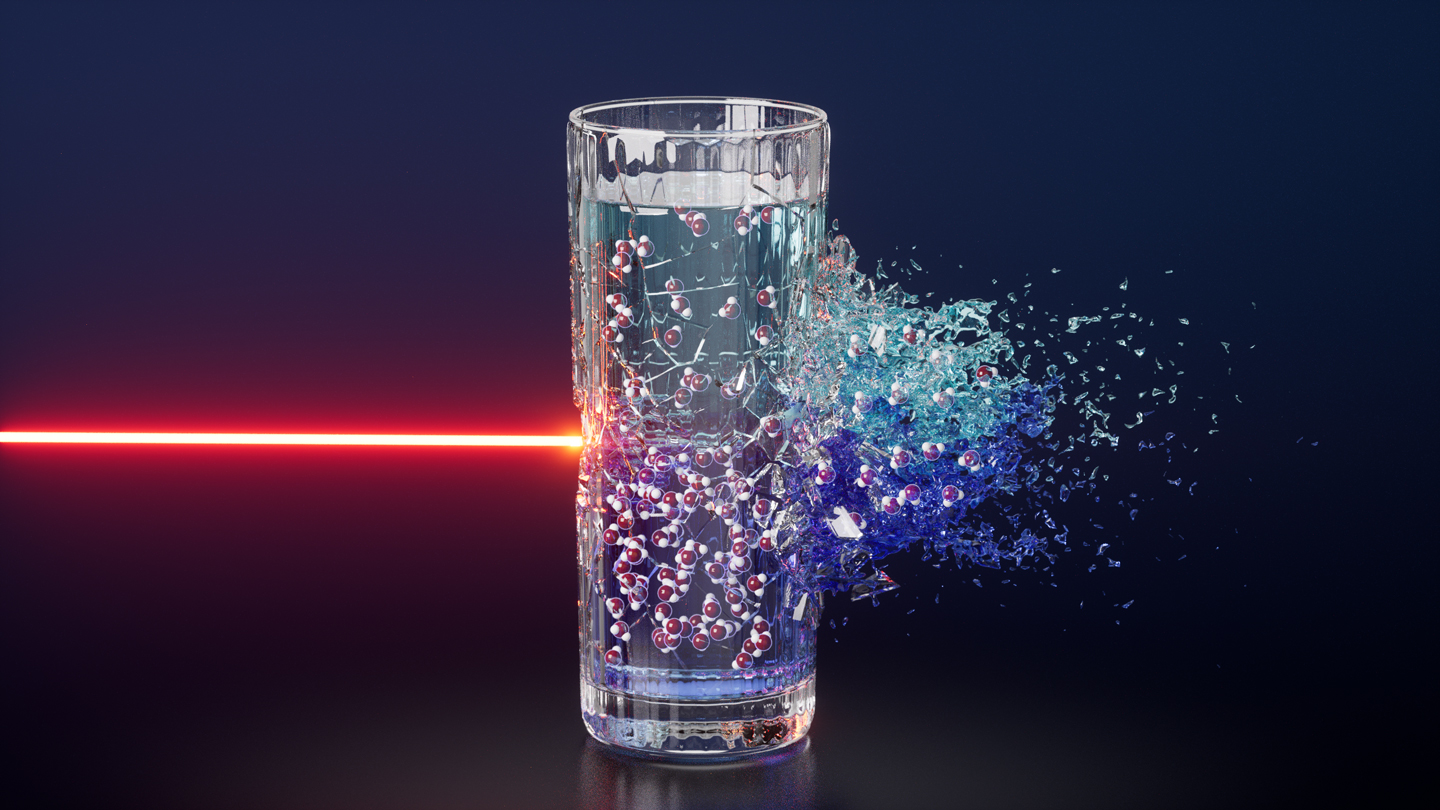
Water has a newfound ‘critical point’ that may help explain its quirks Skip to content Subscribe today Every print subscription comes with full digital access Subscribe Now Menu All Topics Health Humans Anthropology Health & Medicine Archaeology Psychology View All Life Animals Plants Ecosystems Paleontology Neuroscience Genetics Microbes View All Earth Agriculture Climate Oceans Environment View All Physics Materials Science Quantum Physics Particle Physics View All Space Astronomy Planetary Science Cosmology View All Magazine Menu All Stories Multimedia Reviews Puzzles Collections Educator Portal Century of Science Unsung characters Coronavirus Outbreak Newsletters Investors Lab About SN Explores Our Store SIGN IN Donate Home INDEPENDENT JOURNALISM SINCE 1921 SIGN IN Search Open search Close search Home INDEPENDENT JOURNALISM SINCE 1921 All Topics Earth Agriculture Climate Oceans Environment Humans Anthropology Health & Medicine Archaeology Psychology Life Animals Plants Ecosystems Paleontology Neuroscience Genetics Microbes Physics Materials Science Quantum Physics Particle Physics Space Astronomy Planetary Science Cosmology Tech Computing Artificial Intelligence Chemistry Math Science & Society All Topics Health Humans Humans Anthropology Health & Medicine Archaeology Psychology Recent posts in Humans Paleontology Early apes may not have evolved in East Africa By Jake BuehlerMarch 26, 2026 Science & Society Social media can be addictive, a jury finds. Research hints at a link By Sujata GuptaMarch 26, 2026 Health & Medicine Start cholesterol tests in childhood, new guidelines say By Erin Garcia de JesúsMarch 26, 2026 Life Life Animals Plants Ecosystems Paleontology Neuroscience Genetics Microbes Recent posts in Life Animals How snakes defy gravity to stand tall By Rohini Subrahmanyam11 hours ago Animals Watch the first video of a sperm whale birth captured by scientists By Lily BurtonMarch 26, 2026 Paleontology Early apes may not have evolved in East Africa By Jake BuehlerMarch 26, 2026 Earth Earth Agriculture Climate Oceans Environment Recent posts in Earth Space How realistic is Project Hail Mary? By Tina Hesman Saey and Carolyn GramlingMarch 20, 2026 Earth Earth’s continental plates were moving 3.48 billion years ago By Douglas FoxMarch 19, 2026 Microbes How warming is shifting microbial worlds By Erin Garcia de JesúsMarch 19, 2026 Physics Physics Materials Science Quantum Physics Particle Physics Recent posts in Physics Physics Water has a newfound ‘critical point’ that may help explain its quirks By Emily ConoverMarch 26, 2026 Particle Physics Antimatter traveled by truck for the first time By Emily ConoverMarch 24, 2026 Physics These insects fly with their legs. Physics explains how By Emily ConoverMarch 24, 2026 Space Space Astronomy Planetary Science Cosmology Recent posts in Space Astronomy A rare star in a tiny galaxy preserves a record of the early universe By Jay Bennett15 hours ago Space NASA races to have the first moon base and nuclear-propulsion spacecraft By Nikk Ogasa and Lisa GrossmanMarch 25, 2026 Planetary Science A private moon lander challenges ideas about lunar volcanism By Lisa GrossmanMarch 25, 2026 News Physics Water has a newfound ‘critical point’ that may help explain its quirks Supercooled water exists in two liquid forms that become indistinguishable under the right conditions Supercooled water can exist in a denser liquid with more closely packed molecules (bottom in this illustration) or a less dense liquid. By probing supercooled water with lasers, scientists found the critical point — the temperature and pressure at which those two phases become one. POSTECH University, South Korea By Emily Conover March 26, 2026 at 2:00 pm Share this:Share Share via email (Opens in new window) Email Share on Facebook (Opens in new window) Facebook Share on Reddit (Opens in new window) Reddit Share on X (Opens in new window) X Print (Opens in new window) Print A hidden feature of water, long submerged, has finally been brought to the surface. New experiments have revealed supercooled water’s critical point — a specific pressure and temperature at which two distinct phases of water turn into one. The critical point appears at about 210 kelvins (around –63° Celsius) and about 1,000 times the pressure exerted by Earth’s atmosphere at sea level, researchers report in the March 26 Science. The discovery may help explain certain odd properties of the ubiquitous, all-important liquid. Sign up for our newsletter We summarize the week's scientific breakthroughs every Thursday. Water is already known to have a critical point at high temperature. At about 374° C and 218 times atmospheric pressure, the distinction between the liquid and gas phases is erased. Beyond that critical point, water is what’s called a supercritical fluid. Scientists had long predicted a second critical point existed at low temperature, in water that is supercooled, meaning that it temporarily remains liquid below its normal freezing point. “For 20 years or more, many people were waiting to see direct evidence … based on experiments,” says physicist Nicolas Giovambattista of Brooklyn College in New York, who was not involved with the research. “It’s amazing that it finally came.” Certain odd properties of water tipped scientists off to this possibility. For example, most liquids increase in density upon cooling. But water increases in density down to about 4° C where it reaches a maximum. Then it reverses course: Further cooling makes water less dense. And water’s heat capacity, the amount of energy required to increase its temperature a given amount, does a similar about-face. Scientists suspected the flip-flopping properties could be a sign of a critical point lurking at lower temperature. In 2020, experiments provided evidence that supercooled water can take on two different phases: a high-density or a low-density liquid. Those two phases were thought to become one at the critical point, but until now, that hadn’t been observed. Experiments at pressures and temperatures close to the predicted critical point are extremely challenging. That realm is known as “no man’s land” because supercooled water freezes almost instantaneously there. So chemical physicist Anders Nilsson of Stockholm University and colleagues turned to sophisticated tactics. “We have to do everything very quickly,” Nilsson says. The researchers started with tiny samples of special types of ice, called amorphous ice, in which the molecules are jumbled up rather than arranged in a crystalline structure. In experiments at Pohang Accelerator Laboratory in South Korea, researchers hit each sample of ice with a short blast from an infrared laser to melt it. Then, within nanoseconds to microseconds, they probed it with the lab’s X-ray laser. The results revealed the liquid’s structure and density under various pressures and temperatur
Water has a newfound ‘critical point’ that may help explain its quirks