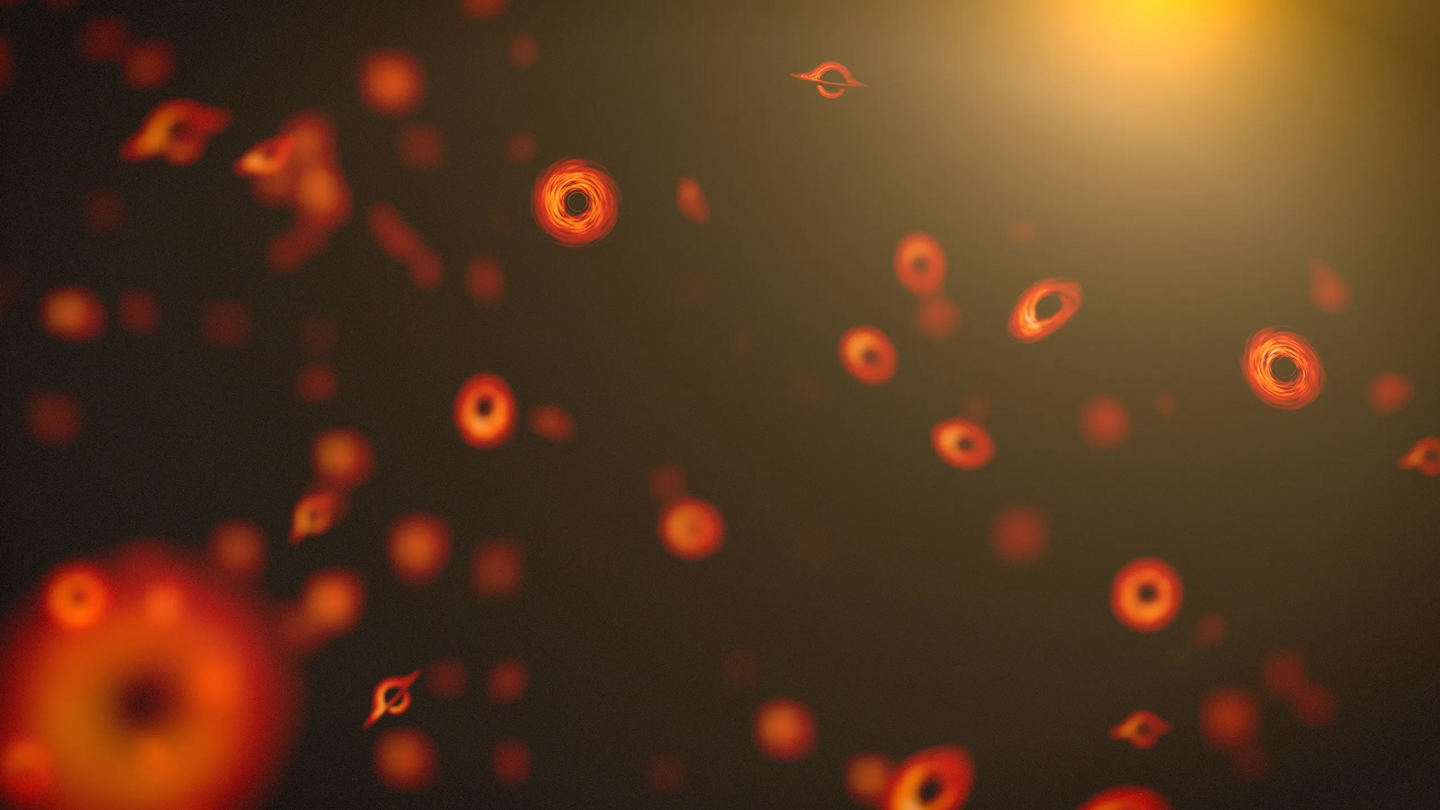
Exploding black holes could explain an antimatter mystery Skip to content Subscribe today Every print subscription comes with full digital access Subscribe Now Menu All Topics Health Humans Anthropology Health & Medicine Archaeology Psychology View All Life Animals Plants Ecosystems Paleontology Neuroscience Genetics Microbes View All Earth Agriculture Climate Oceans Environment View All Physics Materials Science Quantum Physics Particle Physics View All Space Astronomy Planetary Science Cosmology View All Magazine Menu All Stories Multimedia Reviews Puzzles Collections Educator Portal Century of Science Unsung characters Coronavirus Outbreak Newsletters Investors Lab About SN Explores Our Store SIGN IN Donate Home INDEPENDENT JOURNALISM SINCE 1921 SIGN IN Search Open search Close search Home INDEPENDENT JOURNALISM SINCE 1921 All Topics Earth Agriculture Climate Oceans Environment Humans Anthropology Health & Medicine Archaeology Psychology Life Animals Plants Ecosystems Paleontology Neuroscience Genetics Microbes Physics Materials Science Quantum Physics Particle Physics Space Astronomy Planetary Science Cosmology Tech Computing Artificial Intelligence Chemistry Math Science & Society All Topics Health Humans Humans Anthropology Health & Medicine Archaeology Psychology Recent posts in Humans Science & Society Snippets of hair may expose chronic stress in war refugees By Sujata GuptaApril 6, 2026 Health & Medicine When our minds wander to the body, it may affect mental health By Diana KwonApril 3, 2026 Health & Medicine Supreme Court ruling on ‘conversion therapy’ puts medical talk in the hot seat By Aimee CunninghamApril 3, 2026 Life Life Animals Plants Ecosystems Paleontology Neuroscience Genetics Microbes Recent posts in Life Animals For gray whales, San Francisco Bay is becoming a deadly pit stop By Gennaro Tomma2 hours ago Neuroscience Seeing and imagining activate some of the same brain cells By Diana KwonApril 9, 2026 Paleontology Mummified reptile hints at the origins of how we breathe By Carolyn GramlingApril 8, 2026 Earth Earth Agriculture Climate Oceans Environment Recent posts in Earth Animals For gray whales, San Francisco Bay is becoming a deadly pit stop By Gennaro Tomma2 hours ago Climate Emperor penguins are marching toward extinction. Antarctica fur seals too By Carolyn GramlingApril 9, 2026 Environment Hawaii is turning ocean plastic into roads to fight pollution By Sara NovakApril 8, 2026 Physics Physics Materials Science Quantum Physics Particle Physics Recent posts in Physics Cosmology Exploding black holes could explain an antimatter mystery By Emily ConoverApril 10, 2026 Quantum Physics Just 10,000 quantum bits might crack internet encryption schemes By Emily ConoverApril 1, 2026 Quantum Physics Quantum physics can confirm where someone is located By Emily ConoverMarch 30, 2026 Space Space Astronomy Planetary Science Cosmology Recent posts in Space Space Artemis II ends its historic lunar journey By Lisa GrossmanApril 10, 2026 Cosmology Exploding black holes could explain an antimatter mystery By Emily ConoverApril 10, 2026 Space Even before splashdown, Artemis II is delivering a scientific treasure trove By Lisa GrossmanApril 8, 2026 News Cosmology Exploding black holes could explain an antimatter mystery Shock waves in the early universe may have helped matter reign supreme Primordial black holes (illustrated) could explain how the universe came to be formed predominantly from matter, while antimatter is rare. NASA’s Goddard Space Flight Center By Emily Conover April 10, 2026 at 10:00 am Share this:Share Share via email (Opens in new window) Email Share on Facebook (Opens in new window) Facebook Share on Reddit (Opens in new window) Reddit Share on X (Opens in new window) X Print (Opens in new window) Print DENVER — Tiny, exploding black holes might explain one of the biggest mysteries about how the universe, in its current form, came to be. In the cosmos, matter is much more common than antimatter. But scientists don’t know how matter achieved its dominance. Now, a team of physicists reports that matter’s takeover may have involved tiny black holes, born in the first instants after the Big Bang. Those hypothetical primordial black holes would have quickly evaporated and exploded, sending shock waves careening outward. That could have set the stage for matter to take over, physicist Alexandra Klipfel reported in March at the American Physical Society’s Global Physics Summit. Sign up for our newsletter We summarize the week's scientific breakthroughs every Thursday. Scientists believe that the universe formed with equal amounts of matter and antimatter. But matter and antimatter annihilate when they meet. Without something to tip the scales, the universe would have been featureless, containing pure energy. The tiny black holes could have shifted the balance to produce our matter-rich cosmos, enabling the formation of the stars, planets and galaxies within it. If that’s true, it would give scientists a handle on black holes that would otherwise be very hard to study, says theoretical physicist Lucien Heurtier of King’s College London, who was not involved with the research. “It’s very difficult to detect their existence in cosmology because they are gone. They have been gone for a while.”The black holes would have formed from fluctuations in the density of the early universe, with masses around a thousand kilograms each, about that of a small car. These relatively small black holes would have lived and died within the early-universe slurry called the quark-gluon plasma, the phase of matter that existed before protons and neutrons formed. They would have spewed out energetic particles — a phenomenon called Hawking radiation — thereby heating their surroundings. A radiating black hole would have steadily lost mass before going out with a bang, within the first tenth of a billionth of a second of the universe’s existence. Such a blast would have launched a shock wave into the quark-gluon plasma, the researchers report in a related paper submitted March 16 to arXiv.org. The sudden explosion would have injected a large amount of energy into the plasma. “And that heats up a small sphere of our plasma, very, very hot,” Klipfel says. “It’s a really sharp wall,” with different conditions inside and outside the shock. A sharp wall like that would provide conditions necessary to create an excess of matter, the researchers report in another paper submitted March 30 to arXiv.org. If everything in the universe were in a smooth, equilibrium distribution, any process that converted between matter and antimatter would work in both directions at once, resulting in no excess of either matter or antimatter. But conditions on one side of the shock wave would differ drastically from those on the other, in a way that could give matter a boost. Inside a thin shell surrounding such a shock wave, te
Exploding black holes could explain an antimatter mystery