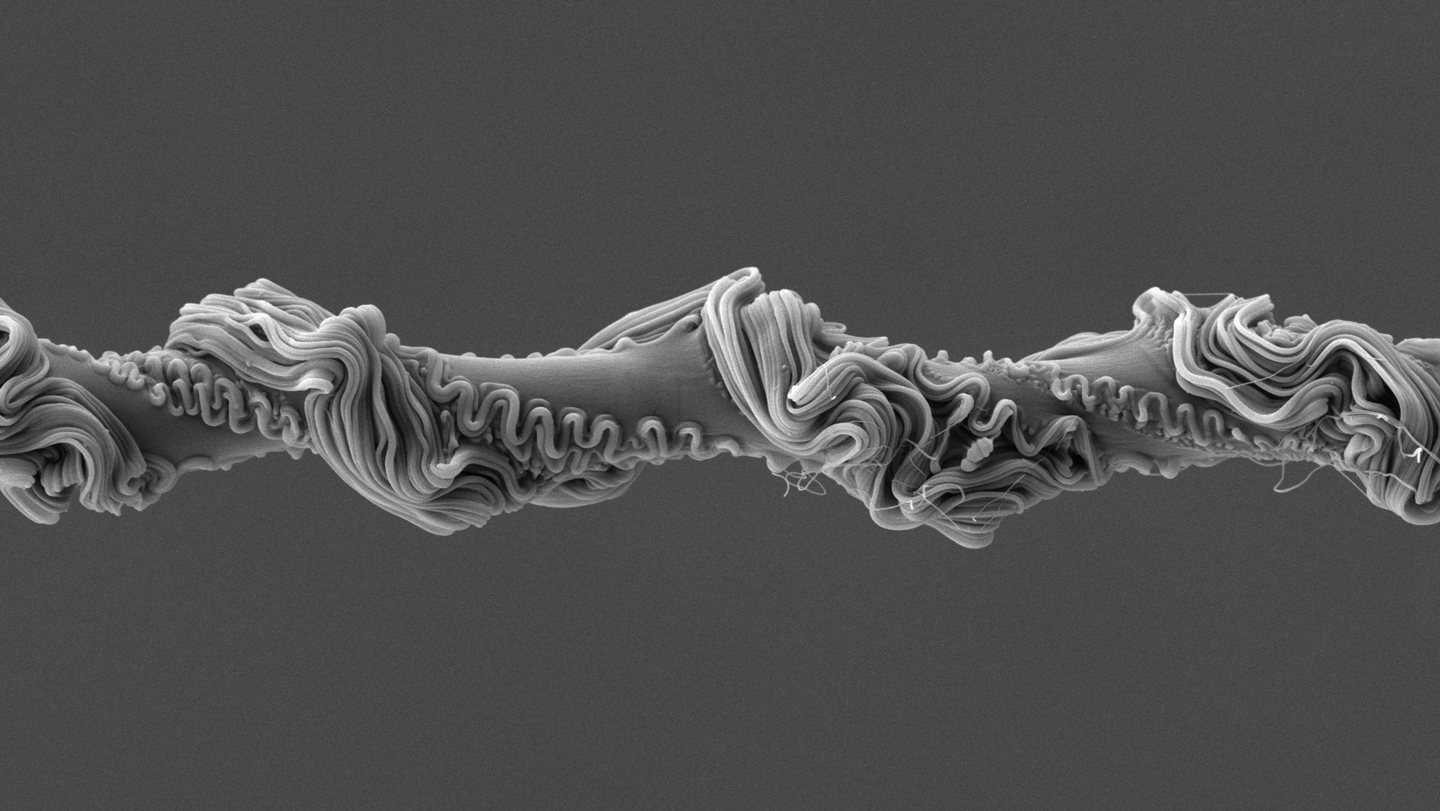
Intricate silk helps net-casting spiders ensnare prey in webs Skip to content Subscribe today Every print subscription comes with full digital access Subscribe Now Menu All Topics Health Humans Anthropology Health & Medicine Archaeology Psychology View All Life Animals Plants Ecosystems Paleontology Neuroscience Genetics Microbes View All Earth Agriculture Climate Oceans Environment View All Physics Materials Science Quantum Physics Particle Physics View All Space Astronomy Planetary Science Cosmology View All Magazine Menu All Stories Multimedia Reviews Puzzles Collections Educator Portal Century of Science Unsung characters Coronavirus Outbreak Newsletters Investors Lab About SN Explores Our Store SIGN IN Donate Home INDEPENDENT JOURNALISM SINCE 1921 SIGN IN Search Open search Close search Home INDEPENDENT JOURNALISM SINCE 1921 All Topics Earth Agriculture Climate Oceans Environment Humans Anthropology Health & Medicine Archaeology Psychology Life Animals Plants Ecosystems Paleontology Neuroscience Genetics Microbes Physics Materials Science Quantum Physics Particle Physics Space Astronomy Planetary Science Cosmology Tech Computing Artificial Intelligence Chemistry Math Science & Society All Topics Health Humans Humans Anthropology Health & Medicine Archaeology Psychology Recent posts in Humans Life An African monkey ate a rope squirrel and came down with mpox By Erin Garcia de Jesús48 minutes ago Health & Medicine A lab on wheels is tracking HIV spread in war-torn Ukraine By Kamal Nahas5 hours ago Archaeology Iron Age mass grave may hold unusual victims: mostly women and children By Tom MetcalfeFebruary 23, 2026 Life Life Animals Plants Ecosystems Paleontology Neuroscience Genetics Microbes Recent posts in Life Life An African monkey ate a rope squirrel and came down with mpox By Erin Garcia de Jesús48 minutes ago Animals Intricate silk helps net-casting spiders ensnare prey in webs By Emily Conover3 hours ago Health & Medicine A lab on wheels is tracking HIV spread in war-torn Ukraine By Kamal Nahas5 hours ago Earth Earth Agriculture Climate Oceans Environment Recent posts in Earth Climate Halting irreversible changes to Antarctica depends on choices made today By Carolyn GramlingFebruary 20, 2026 Climate Snowball Earth might have had a dynamic climate and open seas By Michael MarshallFebruary 19, 2026 Oceans Evolution didn’t wait long after the dinosaurs died By Elie DolginFebruary 13, 2026 Physics Physics Materials Science Quantum Physics Particle Physics Recent posts in Physics Animals Intricate silk helps net-casting spiders ensnare prey in webs By Emily Conover3 hours ago Physics Physicists dream up ‘spacetime quasicrystals’ that could underpin the universe By Emily ConoverFebruary 17, 2026 Physics A precise proton measurement helps put a core theory of physics to the test By Emily ConoverFebruary 11, 2026 Space Space Astronomy Planetary Science Cosmology Recent posts in Space Planetary Science Venus has a massive lava tube By Tom MetcalfeFebruary 23, 2026 Science & Society Project Hail Mary made us wonder how to survive a trip to interstellar space By Tina Hesman SaeyFebruary 20, 2026 Astronomy This inside-out planetary system has astronomers scratching their heads By Adam MannFebruary 12, 2026 Animals Intricate silk helps net-casting spiders ensnare prey in webs Looped structures make webs that are both stretchy and strong The silk of the rufous net-casting spider, shown in a scanning electron microscope image, is simultaneously strong and stretchy, thanks to the loops of silk on its surface. Martin Ramirez and Jonas Wolff By Emily Conover 3 hours ago Share this:Share Share via email (Opens in new window) Email Share on Facebook (Opens in new window) Facebook Share on Reddit (Opens in new window) Reddit Share on X (Opens in new window) X Print (Opens in new window) Print For spiders that fling their webs at prey, a sturdy net is essential. A net-casting spider in search of a meal dangles upside down, holding a web in its legs before launching it at an unsuspecting insect. In the process, parts of the web can stretch to up to 24 times their original size in about a tenth of a second without breaking. The web of the rufous net-casting spider (Asianopis subrufa) pulls off that feat thanks to looping strands that surround a stretchy silk core, researchers report in the Feb. 3 Proceedings of the National Academy of Sciences. Scanning electron microscope images revealed the spider silk’s intricate structure. Sign up for our newsletter We summarize the week's scientific breakthroughs every Thursday. A net-casting spider launches its web at a grasshopper, dramatically stretching the silk fibers in the process.J.O. Wolff et al/PNAS 2026 For most materials, there’s a tradeoff: Substances that stretch tend to break more easily. But the webs of these spiders manage to be both strong and stretchy. As a strand stretches, the loops straighten, and those threads reinforce the core and prevent it from breaking. The spiders customize the amount of coiling in different sections of the web to account for how much each portion needs to stretch. The spider extrudes the loops of silk from a different set of glands than the core fiber, producing a sturdy material. The resulting fibers are beautiful — but deadly. Questions or comments on this article? E-mail us at feedback@sciencenews.org | Reprints FAQ Citations J.O. Wolff et al. Behavioral tuning of spider silk thread stiffness circumvents biomaterial trade-offs. Proceedings of the National Academy of Sciences. Vol. 123, February 3, 2026, e2529200123. doi: 10.1073/pnas.2529200123. About Emily Conover E-mail X Senior physics writer Emily Conover has a Ph.D. in physics from the University of Chicago. She is a two-time winner of the D.C. Science Writers’ Association Newsbrief award and a winner of the Acoustical Society of America’s Science Communication Award. We are at a critical time and supporting science journalism is more important than ever. Science News and our parent organization, the Society for Science, need your help to strengthen scientific literacy and ensure that important societal decisions are made with science in mind. Please subscribe to Science News and add $16 to expand science literacy and understanding. Popular Stories Animals How Greenland sharks defy aging By Meghan RosenJanuary 23, 2026 Health & Medicine New dietary guidelines flip the food pyramid By Tina Hesman SaeyJanuary 7, 2026 Animals Spider silk-making organs evolved due to a 400-million-year-old genetic oops By Jake BuehlerJanuary 27, 2026 More Stories from Science News on Animals Life An African monkey ate a rope squirrel and came down with mpox By Erin Garcia de Jesús48 minutes ago Health & Medicine This itch-triggering protein also sends signals to stop scratching By Tina Hesman SaeyFebruary 21, 2026 Paleontology A mouth built for efficiency may have helped the earliest bird fly By Jay B
Intricate silk helps net-casting spiders ensnare prey in webs