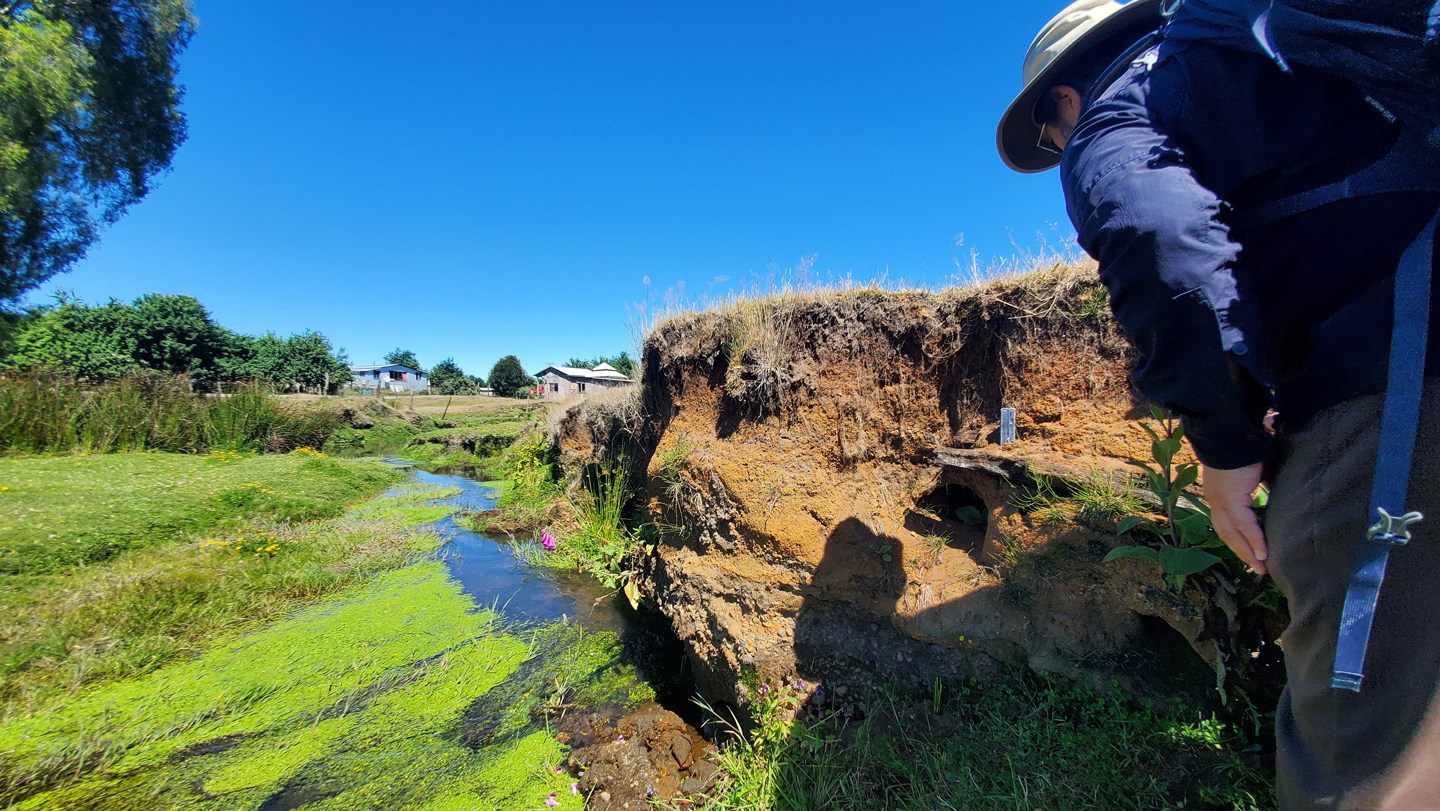
A new study questions when people first reached South America Skip to content Subscribe today Every print subscription comes with full digital access Subscribe Now Menu All Topics Health Humans Anthropology Health & Medicine Archaeology Psychology View All Life Animals Plants Ecosystems Paleontology Neuroscience Genetics Microbes View All Earth Agriculture Climate Oceans Environment View All Physics Materials Science Quantum Physics Particle Physics View All Space Astronomy Planetary Science Cosmology View All Magazine Menu All Stories Multimedia Reviews Puzzles Collections Educator Portal Century of Science Unsung characters Coronavirus Outbreak Newsletters Investors Lab About SN Explores Our Store SIGN IN Donate Home INDEPENDENT JOURNALISM SINCE 1921 SIGN IN Search Open search Close search Home INDEPENDENT JOURNALISM SINCE 1921 All Topics Earth Agriculture Climate Oceans Environment Humans Anthropology Health & Medicine Archaeology Psychology Life Animals Plants Ecosystems Paleontology Neuroscience Genetics Microbes Physics Materials Science Quantum Physics Particle Physics Space Astronomy Planetary Science Cosmology Tech Computing Artificial Intelligence Chemistry Math Science & Society All Topics Health Humans Humans Anthropology Health & Medicine Archaeology Psychology Recent posts in Humans Archaeology A new study questions when people first reached South America By Tom Metcalfe10 hours ago Health & Medicine Are pig organs the future of transplantation? By Meghan RosenMarch 17, 2026 Health & Medicine Smartwatch data can be used to assess early diabetes risk By Elie DolginMarch 16, 2026 Life Life Animals Plants Ecosystems Paleontology Neuroscience Genetics Microbes Recent posts in Life Microbes How warming is shifting microbial worlds By Erin Garcia de Jesús15 hours ago Animals Sharks are ingesting drugs in the Bahamas By Joshua Rapp LearnMarch 18, 2026 Animals Platypus fur has a surprising feature seen only in bird feathers By Jude ColemanMarch 17, 2026 Earth Earth Agriculture Climate Oceans Environment Recent posts in Earth Earth Earth’s continental plates were moving 3.48 billion years ago By Douglas Fox10 hours ago Microbes How warming is shifting microbial worlds By Erin Garcia de Jesús15 hours ago Earth To make a ‘Snowball Earth,’ sci-fi moves fast. Geology is far slower By Carolyn GramlingMarch 18, 2026 Physics Physics Materials Science Quantum Physics Particle Physics Recent posts in Physics Physics A static electricity mystery comes to the surface By Emily ConoverMarch 18, 2026 Plants Tree tops sparkle with electricity during thunderstorms By Lily BurtonMarch 10, 2026 Physics When the pressure’s off, this superconductor appears to break records By Emily ConoverMarch 9, 2026 Space Space Astronomy Planetary Science Cosmology Recent posts in Space Space One possible recipe for life on Titan is a bust By Tina Hesman SaeyMarch 11, 2026 Astronomy A strange ‘chirp’ in a brilliant stellar blast points to a magnetar By Jay BennettMarch 11, 2026 Planetary Science NASA’s DART spacecraft changed an asteroid’s orbit around the sun By Lisa GrossmanMarch 6, 2026 News Archaeology A new study questions when people first reached South America Chile’s Monte Verde site may be thousands of years younger than previously thought, data suggest Researcher Claudio Latorre, a professor of paleoecology at the Pontificia Universidad Católica de Chile, examines ancient wood near the Monte Verde archaeological site in southern Chile. Todd Surovell By Tom Metcalfe 10 hours ago Share this:Share Share via email (Opens in new window) Email Share on Facebook (Opens in new window) Facebook Share on Reddit (Opens in new window) Reddit Share on X (Opens in new window) X Print (Opens in new window) Print A landmark archaeological site in Chile may be thousands of years younger than originally thought, a new study claims. If validated, the finding would upend a key piece of evidence that humans reached South America about 14,500 years ago and force a rethink of how and when the Americas were first settled. The site, called Monte Verde, has long underpinned claims that people were living in South America more than 1,000 years before the Clovis culture, which is dated to around 13,000 years ago. But the new analysis, published March 19 in Science, suggests people lived at Monte Verde only 4,200 to 8,200 years ago. Sign up for our newsletter We summarize the week's scientific breakthroughs every Thursday. Not everyone agrees: The archaeologist who first dated Monte Verde calls the new work a misreading of the site, and several outside experts say the evidence is not convincing. Archaeologist Todd Surovell of the University of Wyoming in Laramie gets why there’s criticism. “In terms of understanding the peopling of the Americas, this site has been incredibly important for 30 years,” he says. “The interpretation that it is one of the oldest sites in the Americas has become a universally accepted fact…. I anticipate our work to be not only impactful but controversial.” Monte Verde, about 800 kilometers south of Santiago, is one of the most famous archaeological sites in South America. Todd Surovell Surovell and his colleagues say a key to their claims is their discovery of a layer of volcanic ash at the site, which they determined was from an eruption of the Michinmahuida volcano in Patagonia about 11,000 years ago. The team says the ash layer is beneath the evidence of human occupation and must have predated it. “Some archaeologists will say our findings change everything about our understanding of the peopling of the Americas, [but] some archaeologists will tell you it hardly changes anything,” Surovell says. “I think that disagreement speaks to the nature of the discipline and really shows how much we don’t know.” The Monte Verde site was discovered in late 1975, about 800 kilometers south of Santiago. Excavations, led in part by anthropologist and archaeologist Tom Dillehay then at the Universidad Austral de Chile, revealed remarkably well-preserved pieces of wood, leather, rope, plant fibers and the remains of wooden huts that had been buried in a peat bog at the swampy location. Those finds led Dillehay, now at Vanderbilt University in Nashville, and his colleagues to report in 2008 that people were living at Monte Verde between 13,980 and 14,220 years ago. (Dillehay later updated the age to about 14,500 years ago.) That put Monte Verde’s occupation at roughly 1,500 years before what was until then thought to be the oldest evidence of people in the Americas. That evidence — including spear points and butchered mammoth remains — comes from archaeological sites near the small New Mexico city of Clovis, which have been dated to about 13,000 years ago. The idea that people were in South America “pre-Clovis,” based mainly on the findings from Monte Verde, has since become a central tenet of archaeology i
A new study questions when people first reached South America