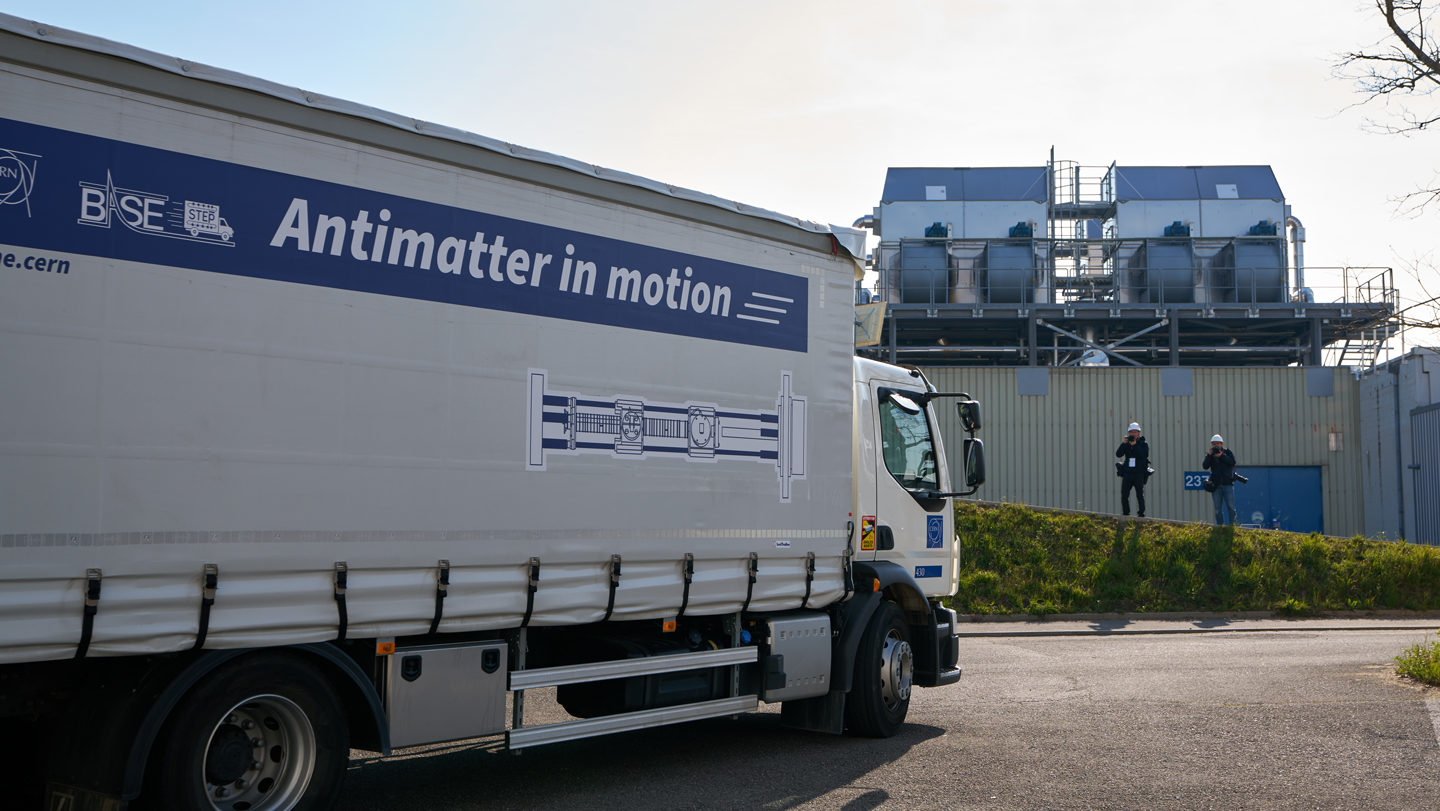
Antimatter traveled by truck for the first time Skip to content Subscribe today Every print subscription comes with full digital access Subscribe Now Menu All Topics Health Humans Anthropology Health & Medicine Archaeology Psychology View All Life Animals Plants Ecosystems Paleontology Neuroscience Genetics Microbes View All Earth Agriculture Climate Oceans Environment View All Physics Materials Science Quantum Physics Particle Physics View All Space Astronomy Planetary Science Cosmology View All Magazine Menu All Stories Multimedia Reviews Puzzles Collections Educator Portal Century of Science Unsung characters Coronavirus Outbreak Newsletters Investors Lab About SN Explores Our Store SIGN IN Donate Home INDEPENDENT JOURNALISM SINCE 1921 SIGN IN Search Open search Close search Home INDEPENDENT JOURNALISM SINCE 1921 All Topics Earth Agriculture Climate Oceans Environment Humans Anthropology Health & Medicine Archaeology Psychology Life Animals Plants Ecosystems Paleontology Neuroscience Genetics Microbes Physics Materials Science Quantum Physics Particle Physics Space Astronomy Planetary Science Cosmology Tech Computing Artificial Intelligence Chemistry Math Science & Society All Topics Health Humans Humans Anthropology Health & Medicine Archaeology Psychology Recent posts in Humans Archaeology Neandertals made antibacterial ointment, but may not have known it By Martin J. Kernan9 hours ago Health & Medicine Amid vaccine policy whiplash, here’s how a pediatrician talks to families By Aimee CunninghamMarch 20, 2026 Health & Medicine GLP-1 microdosers are chasing longevity By Jamie DucharmeMarch 20, 2026 Life Life Animals Plants Ecosystems Paleontology Neuroscience Genetics Microbes Recent posts in Life Physics These insects fly with their legs. Physics explains how By Emily Conover7 hours ago Animals Female giant rainforest mantises grow up to strike harder than males By Susan MiliusMarch 23, 2026 Space How realistic is Project Hail Mary? By Tina Hesman Saey and Carolyn GramlingMarch 20, 2026 Earth Earth Agriculture Climate Oceans Environment Recent posts in Earth Space How realistic is Project Hail Mary? By Tina Hesman Saey and Carolyn GramlingMarch 20, 2026 Earth Earth’s continental plates were moving 3.48 billion years ago By Douglas FoxMarch 19, 2026 Microbes How warming is shifting microbial worlds By Erin Garcia de JesúsMarch 19, 2026 Physics Physics Materials Science Quantum Physics Particle Physics Recent posts in Physics Particle Physics Antimatter traveled by truck for the first time By Emily Conover1 hour ago Physics These insects fly with their legs. Physics explains how By Emily Conover7 hours ago Animals Female giant rainforest mantises grow up to strike harder than males By Susan MiliusMarch 23, 2026 Space Space Astronomy Planetary Science Cosmology Recent posts in Space Space In a rare event, the moon got a massive new crater By Lisa GrossmanMarch 23, 2026 Space How realistic is Project Hail Mary? By Tina Hesman Saey and Carolyn GramlingMarch 20, 2026 Space One possible recipe for life on Titan is a bust By Tina Hesman SaeyMarch 11, 2026 News Particle Physics Antimatter traveled by truck for the first time Scientists at CERN transported 92 antiprotons eight kilometers across the lab grounds Scientists at CERN transported antimatter in a truck (shown) for the first time. CERN By Emily Conover 1 hour ago Share this:Share Share via email (Opens in new window) Email Share on Facebook (Opens in new window) Facebook Share on Reddit (Opens in new window) Reddit Share on X (Opens in new window) X Print (Opens in new window) Print Special delivery: antimatter. Scientists have completed the first-ever transport of antimatter by truck. On March 24, researchers carried antiprotons, the negatively charged counterparts of protons, inside a magnetic trap on a truck. The particles, created at the European particle physics laboratory CERN in Geneva, traveled about eight kilometers to another site within the lab before the trap was delivered, contents intact. That’s quite a feat because antimatter annihilates when it comes into contact with matter. So the antiprotons were corralled with electromagnetic fields to prevent them from banging into the walls of their container while trucking along. The BASE-STEP project’s antimatter trap (shown) was loaded onto a truck before an eight-kilometer trip. Magnetic fields prevent the particles from slamming into the walls of the trap and annihilating as the truck jiggles.CERN The demonstration, which followed a test with protons in 2024, is part of an effort called BASE-STEP. Eventually, scientists hope to use BASE-STEP’s technology to bring antiprotons from CERN to facilities around Europe. There, scientists will build carefully controlled experiments, free from the stray magnetic fields pervading the accelerator facility at CERN that produced the antimatter. Those careful experiments could help scientists better understand why matter is common in the universe, while antimatter is rare. It’s thought that the Big Bang produced matter and antimatter in equal parts. Something must have tipped the balance in matter’s favor. So scientists have been carefully scrutinizing antimatter particles’ properties, such as their charge-to-mass ratios, atomic energy levels, response to gravity and the like, to search for any discrepancies with matter. The new portability demonstration is the first step toward antimatter experiments of a new level of quality, physicist Stefan Ulmer of RIKEN in Wako, Japan, said at a news conference announcing the achievement. “This is a starting point of a really exciting journey.” Questions or comments on this article? E-mail us at feedback@sciencenews.org | Reprints FAQ About Emily Conover E-mail X Senior physics writer Emily Conover has a Ph.D. in physics from the University of Chicago. She is a two-time winner of the D.C. Science Writers’ Association Newsbrief award and a winner of the Acoustical Society of America’s Science Communication Award. We are at a critical time and supporting science journalism is more important than ever. Science News and our parent organization, the Society for Science, need your help to strengthen scientific literacy and ensure that important societal decisions are made with science in mind. Please subscribe to Science News and add $16 to expand science literacy and understanding. Popular Stories Health & Medicine GLP-1 microdosers are chasing longevity By Jamie DucharmeMarch 20, 2026 Neuroscience Why is math harder for some kids? Brain scans offer clues By Lily BurtonFebruary 27, 2026 Space In a rare event, the moon got a massive new crater By Lisa GrossmanMarch 23, 2026 More Stories from Science News on Particle Physics Physics The only U.S. particle collider shuts down – so a new one may rise By Emily ConoverFebruary 6, 2026 Particle Physics Physicists discovered neutrinos 70 years ago. The ghostly particles still have s
Antimatter traveled by truck for the first time