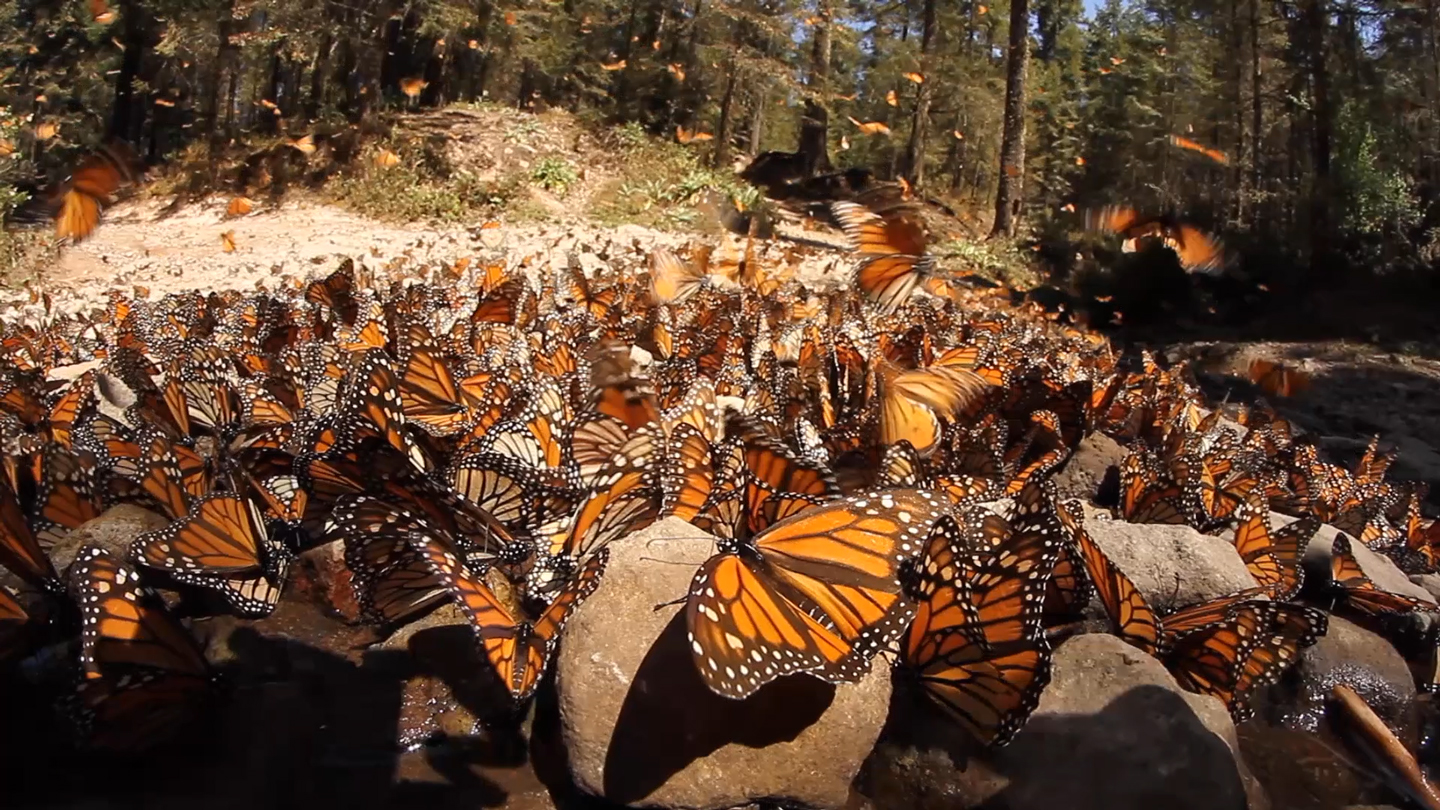
Climate change could threaten monarch mass migration Skip to content Subscribe today Every print subscription comes with full digital access Subscribe Now Menu All Topics Health Humans Anthropology Health & Medicine Archaeology Psychology View All Life Animals Plants Ecosystems Paleontology Neuroscience Genetics Microbes View All Earth Agriculture Climate Oceans Environment View All Physics Materials Science Quantum Physics Particle Physics View All Space Astronomy Planetary Science Cosmology View All Magazine Menu All Stories Multimedia Reviews Puzzles Collections Educator Portal Century of Science Unsung characters Coronavirus Outbreak Newsletters Investors Lab About SN Explores Our Store SIGN IN Donate Home INDEPENDENT JOURNALISM SINCE 1921 SIGN IN Search Open search Close search Home INDEPENDENT JOURNALISM SINCE 1921 All Topics Earth Agriculture Climate Oceans Environment Humans Anthropology Health & Medicine Archaeology Psychology Life Animals Plants Ecosystems Paleontology Neuroscience Genetics Microbes Physics Materials Science Quantum Physics Particle Physics Space Astronomy Planetary Science Cosmology Tech Computing Artificial Intelligence Chemistry Math Science & Society All Topics Health Humans Humans Anthropology Health & Medicine Archaeology Psychology Recent posts in Humans Life An African monkey ate a rope squirrel and came down with mpox By Erin Garcia de JesúsFebruary 24, 2026 Health & Medicine A lab on wheels is tracking HIV spread in war-torn Ukraine By Kamal NahasFebruary 24, 2026 Archaeology Iron Age mass grave may hold unusual victims: mostly women and children By Tom MetcalfeFebruary 23, 2026 Life Life Animals Plants Ecosystems Paleontology Neuroscience Genetics Microbes Recent posts in Life Animals Climate change could threaten monarch mass migration By Erin Garcia de Jesús49 minutes ago Animals Keeping a beat wins caterpillars friends in low places By Jake Buehler14 hours ago Life An African monkey ate a rope squirrel and came down with mpox By Erin Garcia de JesúsFebruary 24, 2026 Earth Earth Agriculture Climate Oceans Environment Recent posts in Earth Animals Climate change could threaten monarch mass migration By Erin Garcia de Jesús49 minutes ago Earth Metal pollution from a rocket reentry detected for the first time By Adam Mann2 hours ago Climate Halting irreversible changes to Antarctica depends on choices made today By Carolyn GramlingFebruary 20, 2026 Physics Physics Materials Science Quantum Physics Particle Physics Recent posts in Physics Physics Here’s why sneakers squeak on the basketball court By Emily Conover4 hours ago Animals Intricate silk helps net-casting spiders ensnare prey in webs By Emily ConoverFebruary 24, 2026 Physics Physicists dream up ‘spacetime quasicrystals’ that could underpin the universe By Emily ConoverFebruary 17, 2026 Space Space Astronomy Planetary Science Cosmology Recent posts in Space Earth Metal pollution from a rocket reentry detected for the first time By Adam Mann2 hours ago Planetary Science Venus has a massive lava tube By Tom MetcalfeFebruary 23, 2026 Science & Society Project Hail Mary made us wonder how to survive a trip to interstellar space By Tina Hesman SaeyFebruary 20, 2026 Animals Climate change could threaten monarch mass migration Suitable habitat in Mexico may shift south, fracturing existing migration routes ⏸ Monarch butterflies (Danus plexippus) rest on rocks in Mexico’s Biosphere Reserve of the Monarch Butterfly, a protected area where millions of the insects spend the winter before migrating north in the spring. AmericanWildlife/Getty Images By Erin Garcia de Jesús 49 minutes ago Share this:Share Share via email (Opens in new window) Email Share on Facebook (Opens in new window) Facebook Share on Reddit (Opens in new window) Reddit Share on X (Opens in new window) X Print (Opens in new window) Print Climate change may threaten North America’s iconic mass monarch butterfly migration. Every fall, millions of monarchs (Danaus plexippus) travel thousands of kilometers over North America as they leave their breeding grounds in Canada and the United States for wintering grounds in a mountainous part of central Mexico. The butterflies make the trek back north over multiple generations when temperatures warm in the spring and summer months, following the growth of milkweed (Asclepias), their preferred food source. Sign up for our newsletter We summarize the week's scientific breakthroughs every Thursday. But Mexico’s suitable monarch overwintering habitat could shift south as the climate changes in decades to come, researchers report February 25 in PLOS Climate. That could lengthen an already arduous journey and increase the energy required to make the trip. That extra distance might push some individuals to stay in Mexico instead of continuing north, says Carolina Ureta, a biologist at the National Autonomous University of Mexico in Mexico City. “In this case, the species is not in danger because of climate change, but the migration might be.” Monarchs are on the decline in North America. Habitat loss, extreme weather, pesticides and parasites are among the reasons fewer insects reach their winter home. Populations in central Mexico, once nearly 700 million individuals strong, have declined by more than 80 percent since the 1990s. Citizen scientists have noticed that some monarchs seem to remain in northeastern or central Mexico, says Víctor Sánchez Cordero, a conservation biologist also at the National Autonomous University of Mexico. “That makes sense because not all monarch populations worldwide migrate.” Butterflies in Chile, New Zealand and across Europe, for instance, don’t travel long distances. But whether climate change might alter North American monarchs’ epic transcontinental journey was unknown. Ureta, Sánchez Cordero and colleagues leveraged computer simulations to predict where in Mexico monarchs might find milkweed, the only plant on which monarchs lay eggs and that caterpillars feed on. Suitable monarch habitat could decline by 2070, the team found. Some simulations taking climate, biology and environment into account suggest a drop from 19,500 square kilometers of ideal habitat to roughly 8,000 square kilometers. Climate change could also push that habitat south of the insects’ existing overwintering sites, fracturing and lengthening their migratory route. Making that return flight north could take more energy than it’s worth, Ureta says, and some individuals may stay instead. Wing size could be a helpful indicator to help researchers figure out if butterflies are staying or going: Resident populations in other parts of the world tend to have a smaller wingspan than migrants. Questions or comments on this article? E-mail us at feedback@sciencenews.org | Reprints FAQ Citations V. Sánchez-Cordero et al. Regional risk
Climate change could threaten monarch mass migration