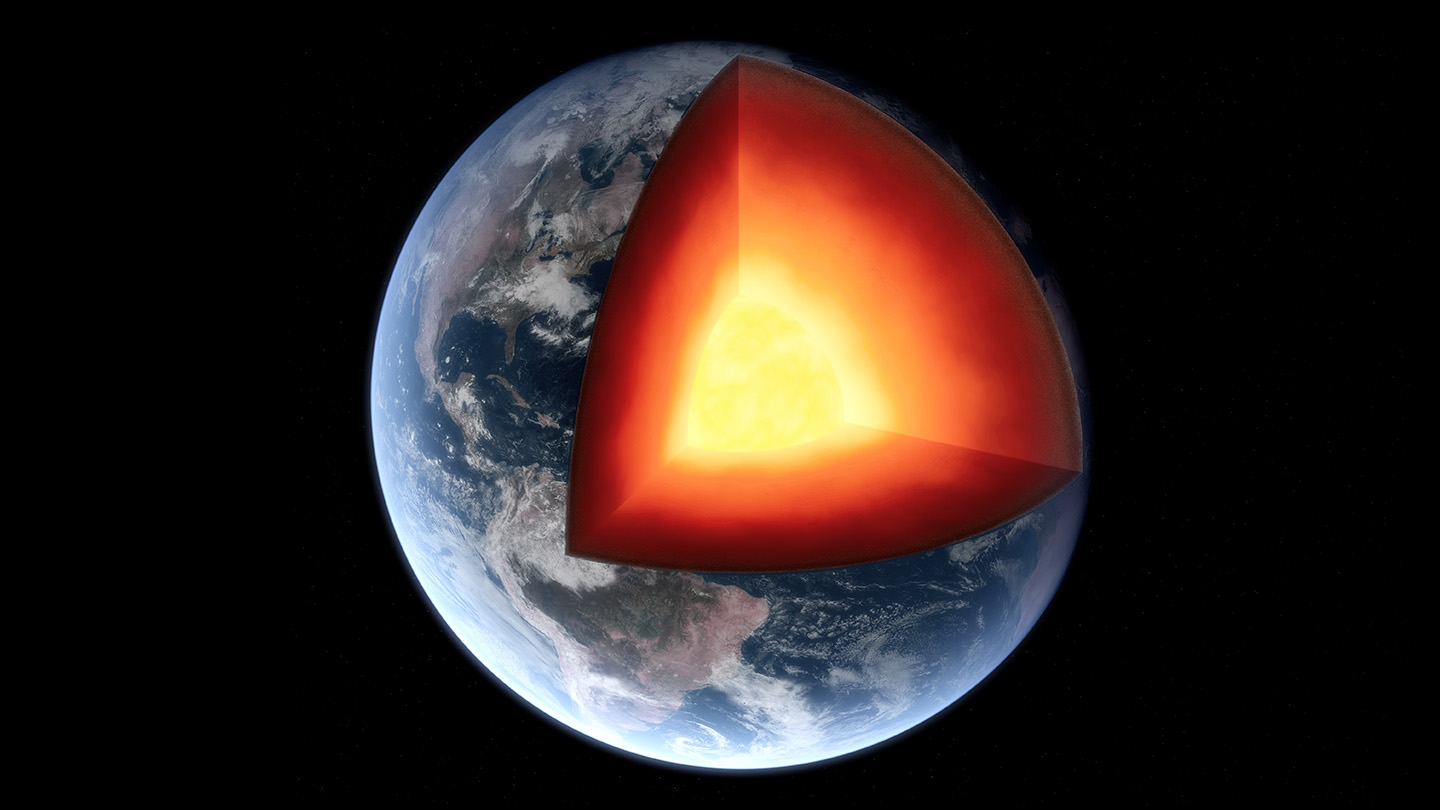
Earth’s core may hide dozens of oceans of hydrogen Skip to content Subscribe today Every print subscription comes with full digital access Subscribe Now Menu All Topics Health Humans Anthropology Health & Medicine Archaeology Psychology View All Life Animals Plants Ecosystems Paleontology Neuroscience Genetics Microbes View All Earth Agriculture Climate Oceans Environment View All Physics Materials Science Quantum Physics Particle Physics View All Space Astronomy Planetary Science Cosmology View All Magazine Menu All Stories Multimedia Reviews Puzzles Collections Educator Portal Century of Science Unsung characters Coronavirus Outbreak Newsletters Investors Lab About SN Explores Our Store SIGN IN Donate Home INDEPENDENT JOURNALISM SINCE 1921 SIGN IN Search Open search Close search Home INDEPENDENT JOURNALISM SINCE 1921 All Topics Earth Agriculture Climate Oceans Environment Humans Anthropology Health & Medicine Archaeology Psychology Life Animals Plants Ecosystems Paleontology Neuroscience Genetics Microbes Physics Materials Science Quantum Physics Particle Physics Space Astronomy Planetary Science Cosmology Tech Computing Artificial Intelligence Chemistry Math Science & Society All Topics Health Humans Humans Anthropology Health & Medicine Archaeology Psychology Recent posts in Humans Health & Medicine A simple shift in schedule could make cancer immunotherapy work better By Elie DolginFebruary 12, 2026 Health & Medicine This baby sling turns sunlight into treatment for newborn jaundice By Elie DolginFebruary 12, 2026 Health & Medicine Antibiotics can treat appendicitis for many patients, no surgery needed By Laura DattaroFebruary 10, 2026 Life Life Animals Plants Ecosystems Paleontology Neuroscience Genetics Microbes Recent posts in Life Oceans Evolution didn’t wait long after the dinosaurs died By Elie Dolgin2 hours ago Animals A sea turtle boom may be hiding a population collapse By Melissa Hobson4 hours ago Ecosystems Food chains in Caribbean coral reefs are getting shorter By Erin Garcia de JesúsFebruary 11, 2026 Earth Earth Agriculture Climate Oceans Environment Recent posts in Earth Oceans Evolution didn’t wait long after the dinosaurs died By Elie Dolgin2 hours ago Earth Earth’s core may hide dozens of oceans of hydrogen By Nikk OgasaFebruary 10, 2026 Animals Some dung beetles dig deep to keep their eggs cool By Elizabeth PennisiFebruary 4, 2026 Physics Physics Materials Science Quantum Physics Particle Physics Recent posts in Physics Physics A precise proton measurement helps put a core theory of physics to the test By Emily ConoverFebruary 11, 2026 Physics The only U.S. particle collider shuts down – so a new one may rise By Emily ConoverFebruary 6, 2026 Physics A Greek star catalog from the dawn of astronomy, revealed By Adam MannJanuary 30, 2026 Space Space Astronomy Planetary Science Cosmology Recent posts in Space Astronomy This inside-out planetary system has astronomers scratching their heads By Adam MannFebruary 12, 2026 Space Artemis II is returning humans to the moon with science riding shotgun By Lisa GrossmanFebruary 4, 2026 Physics A Greek star catalog from the dawn of astronomy, revealed By Adam MannJanuary 30, 2026 News Earth Earth’s core may hide dozens of oceans of hydrogen Experiments suggest that Earth’s core is up to 0.36 percent hydrogen by weight Earth’s core may contain vast reserves of the element hydrogen, which can form water if it leaks into the oxygen-rich mantle. fpm/E+/Getty Images Plus By Nikk Ogasa February 10, 2026 at 11:00 am Share this:Share Share via email (Opens in new window) Email Click to share on Facebook (Opens in new window) Facebook Click to share on Reddit (Opens in new window) Reddit Click to share on X (Opens in new window) X Click to print (Opens in new window) Print Listen to this article This is a human-written story voiced by AI. Got feedback? Take our survey . (See our AI policy here .) The oceans are the largest entity on Earth’s surface. All that blue, however, may be dwarfed by an immense reservoir of hydrogen concealed in the planet’s heart. Experiments indicate that enough hydrogen to form dozens of oceans of water may have been entombed in Earth’s core during its formation, researchers report February 10 in Nature Communications. Those chthonic reserves may influence processes on the planet’s surface. Hydrogen does not exist as liquid water in the core, but it becomes water as it escapes upward into the mantle and reacts with oxygen, says geodynamicist Motohiko Murakami of ETH Zurich. “Oxygen is one of the most abundant mineral elements in the mantle.” Sign up for our newsletter We summarize the week's scientific breakthroughs every Thursday. Earlier estimates of the core’s hydrogen reserves varied enormously and were based on indirect measurements of the element’s abundance in iron, taken by adding hydrogen to iron and measuring the resulting volume change. For the new study, Murakami and colleagues went for a more direct approach. The team started with artificial pieces of the core — iron shards enveloped in a hydrogen-bearing glass. The researchers then squeezed the shards between two diamonds in a powerful mechanical press and beamed a laser through the diamonds to heat the samples up to 4,826° Celsius (8,720° Fahrenheit). At those conditions, the samples melted into iron blobs laced with silicon, hydrogen and oxygen. The early core coalesced from such blobs, Murakami says, as much of early Earth was a magma ocean. After quickly cooling and solidifying the samples, the researchers used a special probe to map out the distribution of elements, finding tiny structures that had solidified amid the iron. Silicon and hydrogen were found only within these structures — and in equal amounts of atoms. That one-to-one ratio was key, as earlier experiments, simulations and geophysical observations of the core had already indicated it was 2 to 10 percent silicon by weight. Based on their new calculations, Murakami and colleagues estimate roughly 0.07 to 0.36 percent of the weight of Earth’s core consists of the much lighter hydrogen. “That’s nine to 45 oceans” of water, Murakami says. Over time, some of that hydrogen has probably leaked into the mantle and become water, Murakami says. That water would make it easier for mantle rocks to melt, he says, generating magma and fueling volcanic eruptions all the way up on Earth’s surface. Questions or comments on this article? E-mail us at feedback@sciencenews.org | Reprints FAQ Citations D. Huang et al. Experimental quantification of hydrogen content in the Earth’s core. Nature Communications. Vol. 17, February 10, 2026. doi: 10.1038/s41467-026-68821-6. J. Badro et al. Core formation and core composition from coupled geochemical and geophysical constraints. Proceedings of the National Academy of Sciences. Vol. 112, September 12, 2015. doi: 10.1073/pnas.1505672112.
Earth’s core may hide dozens of oceans of hydrogen