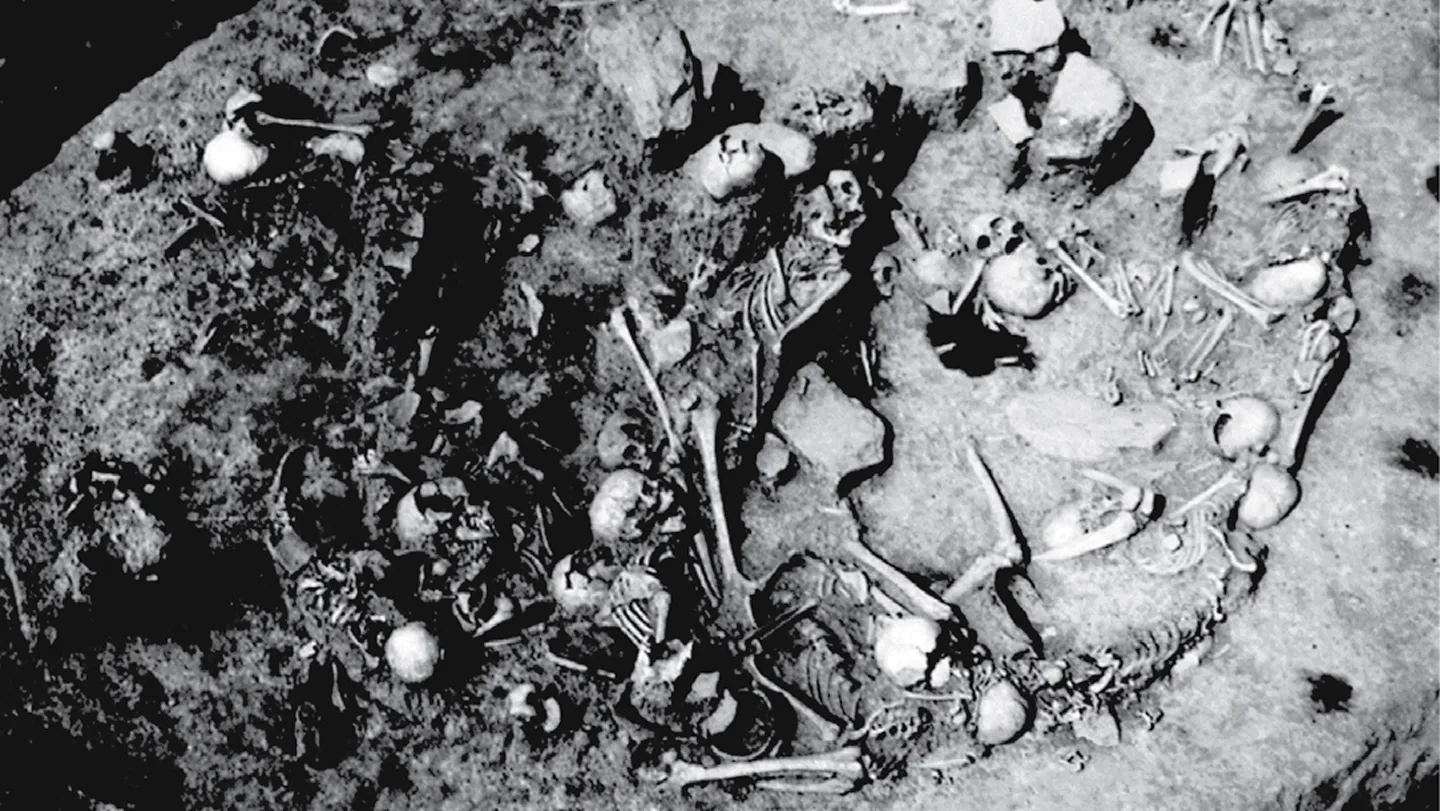
Iron Age mass grave may hold unusual victims: mostly women and children Skip to content Subscribe today Every print subscription comes with full digital access Subscribe Now Menu All Topics Health Humans Anthropology Health & Medicine Archaeology Psychology View All Life Animals Plants Ecosystems Paleontology Neuroscience Genetics Microbes View All Earth Agriculture Climate Oceans Environment View All Physics Materials Science Quantum Physics Particle Physics View All Space Astronomy Planetary Science Cosmology View All Magazine Menu All Stories Multimedia Reviews Puzzles Collections Educator Portal Century of Science Unsung characters Coronavirus Outbreak Newsletters Investors Lab About SN Explores Our Store SIGN IN Donate Home INDEPENDENT JOURNALISM SINCE 1921 SIGN IN Search Open search Close search Home INDEPENDENT JOURNALISM SINCE 1921 All Topics Earth Agriculture Climate Oceans Environment Humans Anthropology Health & Medicine Archaeology Psychology Life Animals Plants Ecosystems Paleontology Neuroscience Genetics Microbes Physics Materials Science Quantum Physics Particle Physics Space Astronomy Planetary Science Cosmology Tech Computing Artificial Intelligence Chemistry Math Science & Society All Topics Health Humans Humans Anthropology Health & Medicine Archaeology Psychology Recent posts in Humans Archaeology Iron Age mass grave may hold unusual victims: mostly women and children By Tom Metcalfe2 hours ago Genetics Wanderlust may be written in our DNA By Elie Dolgin4 hours ago Health & Medicine This itch-triggering protein also sends signals to stop scratching By Tina Hesman SaeyFebruary 21, 2026 Life Life Animals Plants Ecosystems Paleontology Neuroscience Genetics Microbes Recent posts in Life Genetics Wanderlust may be written in our DNA By Elie Dolgin4 hours ago Health & Medicine This itch-triggering protein also sends signals to stop scratching By Tina Hesman SaeyFebruary 21, 2026 Paleontology A mouth built for efficiency may have helped the earliest bird fly By Jay BennettFebruary 19, 2026 Earth Earth Agriculture Climate Oceans Environment Recent posts in Earth Climate Halting irreversible changes to Antarctica depends on choices made today By Carolyn GramlingFebruary 20, 2026 Climate Snowball Earth might have had a dynamic climate and open seas By Michael MarshallFebruary 19, 2026 Oceans Evolution didn’t wait long after the dinosaurs died By Elie DolginFebruary 13, 2026 Physics Physics Materials Science Quantum Physics Particle Physics Recent posts in Physics Physics Physicists dream up ‘spacetime quasicrystals’ that could underpin the universe By Emily ConoverFebruary 17, 2026 Physics A precise proton measurement helps put a core theory of physics to the test By Emily ConoverFebruary 11, 2026 Physics The only U.S. particle collider shuts down – so a new one may rise By Emily ConoverFebruary 6, 2026 Space Space Astronomy Planetary Science Cosmology Recent posts in Space Science & Society Project Hail Mary made us wonder how to survive a trip to interstellar space By Tina Hesman SaeyFebruary 20, 2026 Astronomy This inside-out planetary system has astronomers scratching their heads By Adam MannFebruary 12, 2026 Space Artemis II is returning humans to the moon with science riding shotgun By Lisa GrossmanFebruary 4, 2026 News Archaeology Iron Age mass grave may hold unusual victims: mostly women and children The victims may have been targeted for massacre in a culture clash 3,000 years ago Archaeologists found the ancient Gomolava burial pit in northern Serbia more than 50 years ago, and a new genetic study shows it held mostly women and children. Museum of Vojvodina, reproduced in Fibiger et al./Nature Human Behaviour 2026 By Tom Metcalfe 2 hours ago Share this:Share Share via email (Opens in new window) Email Share on Facebook (Opens in new window) Facebook Share on Reddit (Opens in new window) Reddit Share on X (Opens in new window) X Print (Opens in new window) Print A mass grave from roughly 3,000 years ago in what is now Serbia is filled with the remains of women and children and may indicate they were targeted for organized slaughter. The 9th century B.C. burial pit holds 77 individuals. More than 60 percent were children and more than 70 percent were female, an unusually high proportion, researchers report February 23 in Nature Human Behaviour. Just under three meters across but only half a meter deep, the pit was found more than 50 years ago by Yugoslav archaeologists. The remains are now curated at the Museum of Vojvodina in the nearby Serbian city of Novi Sad, and were only recently analyzed with modern methods. The latest analysis also identifies the remains of about 20 men and boys, but “it’s not a random difference,” says archaeologist Barry Molloy of University College Dublin. “There’s clearly a choice being made about who’s being killed.” Sign up for our newsletter We summarize the week's scientific breakthroughs every Thursday. Mass graves from indiscriminate killing usually have roughly equal numbers of men and women, while wartime massacres usually have more men. Young women and children are often absent from the slaughter of captives — instead, they were probably taken as slaves. Molloy and his colleagues conducted DNA analysis, determined sex via proteins in tooth enamel and studied how the bones are shaped, among other assessments. They suggest the massacre reflects a clash between different cultural groups who wanted to control the area, one of an increasing number of violent episodes after the introduction of farming to Europe between 8,000 and 9,000 years ago. Earlier archaeological studies suggested this escalated from occasional raids to more organized violence as methods of warfare developed, and that it reached its peak around the time of the early Iron Age massacre at Gomolava, an archaeological site near the modern Serbian village of Hrtkovci. Previous research has shown that the people buried at Gomolava were semi-sedentary farming people. The researchers say that ethnological studies and indications that the people in the mass grave were killed by blows from horseback suggest they were attacked and massacred by semi-nomadic herders from another culture. Additional evidence suggests two branches of another farming culture settled nearby, but farther away. At Gomolava, “we seem to have people who liked to control the landscape and use it in a farming way, and this other group looking to move through and keep it open,” Molloy says. “They essentially came into conflict over land ownership.” The high proportion of women and children killed in the massacre may be a sign that they held high status in their farming community, and so were targeted in the killing. “Gomolava was at a flashpoint of all these different ways of using the land,” he says. Bioarchaeologist Mario Novak of the Institute for Anthropologi
Iron Age mass grave may hold unusual victims: mostly women and children