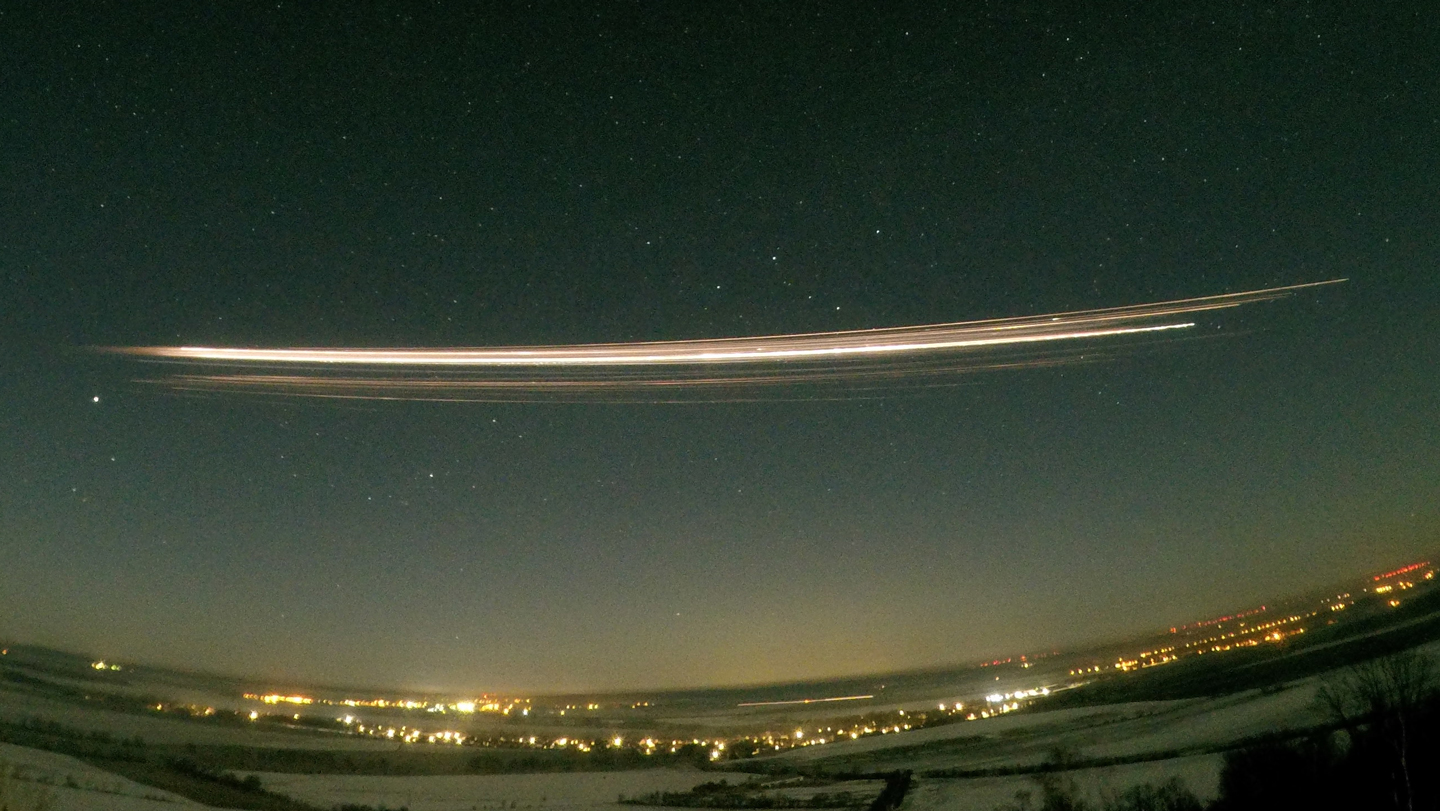
Metal pollution from a rocket reentry detected for the first time Skip to content Subscribe today Every print subscription comes with full digital access Subscribe Now Menu All Topics Health Humans Anthropology Health & Medicine Archaeology Psychology View All Life Animals Plants Ecosystems Paleontology Neuroscience Genetics Microbes View All Earth Agriculture Climate Oceans Environment View All Physics Materials Science Quantum Physics Particle Physics View All Space Astronomy Planetary Science Cosmology View All Magazine Menu All Stories Multimedia Reviews Puzzles Collections Educator Portal Century of Science Unsung characters Coronavirus Outbreak Newsletters Investors Lab About SN Explores Our Store SIGN IN Donate Home INDEPENDENT JOURNALISM SINCE 1921 SIGN IN Search Open search Close search Home INDEPENDENT JOURNALISM SINCE 1921 All Topics Earth Agriculture Climate Oceans Environment Humans Anthropology Health & Medicine Archaeology Psychology Life Animals Plants Ecosystems Paleontology Neuroscience Genetics Microbes Physics Materials Science Quantum Physics Particle Physics Space Astronomy Planetary Science Cosmology Tech Computing Artificial Intelligence Chemistry Math Science & Society All Topics Health Humans Humans Anthropology Health & Medicine Archaeology Psychology Recent posts in Humans Life An African monkey ate a rope squirrel and came down with mpox By Erin Garcia de JesúsFebruary 24, 2026 Health & Medicine A lab on wheels is tracking HIV spread in war-torn Ukraine By Kamal NahasFebruary 24, 2026 Archaeology Iron Age mass grave may hold unusual victims: mostly women and children By Tom MetcalfeFebruary 23, 2026 Life Life Animals Plants Ecosystems Paleontology Neuroscience Genetics Microbes Recent posts in Life Animals Climate change could threaten monarch mass migration By Erin Garcia de Jesús46 minutes ago Animals Keeping a beat wins caterpillars friends in low places By Jake Buehler14 hours ago Life An African monkey ate a rope squirrel and came down with mpox By Erin Garcia de JesúsFebruary 24, 2026 Earth Earth Agriculture Climate Oceans Environment Recent posts in Earth Animals Climate change could threaten monarch mass migration By Erin Garcia de Jesús46 minutes ago Earth Metal pollution from a rocket reentry detected for the first time By Adam Mann2 hours ago Climate Halting irreversible changes to Antarctica depends on choices made today By Carolyn GramlingFebruary 20, 2026 Physics Physics Materials Science Quantum Physics Particle Physics Recent posts in Physics Physics Here’s why sneakers squeak on the basketball court By Emily Conover4 hours ago Animals Intricate silk helps net-casting spiders ensnare prey in webs By Emily ConoverFebruary 24, 2026 Physics Physicists dream up ‘spacetime quasicrystals’ that could underpin the universe By Emily ConoverFebruary 17, 2026 Space Space Astronomy Planetary Science Cosmology Recent posts in Space Earth Metal pollution from a rocket reentry detected for the first time By Adam Mann2 hours ago Planetary Science Venus has a massive lava tube By Tom MetcalfeFebruary 23, 2026 Science & Society Project Hail Mary made us wonder how to survive a trip to interstellar space By Tina Hesman SaeyFebruary 20, 2026 News Earth Metal pollution from a rocket reentry detected for the first time Such pollutants could degrade the ozone layer as space debris accumulates and falls to Earth A Falcon 9 upper stage rocket disintegrates into fragments in this image taken from Collm, Germany on February 25, 2025. A study of the sky at the time found the deteriorating rocket was releasing metal pollutants. Gerd Baumgarten By Adam Mann 2 hours ago Share this:Share Share via email (Opens in new window) Email Share on Facebook (Opens in new window) Facebook Share on Reddit (Opens in new window) Reddit Share on X (Opens in new window) X Print (Opens in new window) Print Listen to this article This is a human-written story voiced by AI. Got feedback? Take our survey . (See our AI policy here .) For the first time, scientists have directly observed metal pollutants leaching from a piece of orbital junk: a SpaceX rocket as it burned in the atmosphere. Such pollutants can damage the ozone layer, meaning the findings will help monitor potential harms from space debris, researchers report February 19 in Communications Earth and Environment. While humans have been launching metal things to orbit for nearly 70 years, the pace has skyrocketed in the past decade. Private companies plan to escalate this in the near future — for instance, SpaceX’s Starlink system, which provides internet to far-flung places, will eventually consist of more than 40,000 satellites in low-Earth orbit. Nearly 10,000 are currently orbiting Earth. Sign up for our newsletter We summarize the week's scientific breakthroughs every Thursday. Each piece of equipment has a planned lifetime of about five years, after which it burns up in the upper atmosphere, releasing metals such as lithium, aluminum and copper, all of which may catalyze chemical reactions that destroy ozone and have other adverse effects. A 2023 study found that about 10 percent of stratospheric particles contain pollutants from burnt-up satellites and rocket stages. That motivated a research team to see if they could directly trace such particles to a piece of reentering space debris. On February 19, 2025, the researchers observed a cloud of lithium about 100 kilometers above Germany blowing out of a Falcon 9 rocket’s upper stage disintegrating over Ireland and the United Kingdom. “A few hours after the reentry of this rocket, we could see 10 times more lithium than we would have observed otherwise,” says Claudia Stolle, a meteorologist at the Leibniz Institute of Atmospheric Physics in Germany. The measurements relied on lidar, which shoots laser pulses tuned to specific wavelengths that bounce off particular materials, such as lithium. The team also ran sophisticated atmospheric simulations to show that the prevailing winds had carried the lithium plume from the spot where the rocket came down in over the North Atlantic to the area over Kühlungsborn, Germany, where the lidar was located. Though there is a natural influx of metals into the atmosphere from meteorites, the combined load of all reentering space debris may one day boost metal pollution by around 40 percent, Stolle and her colleagues conclude. Tracking such contaminants and their effects will become increasingly important as more companies and countries get interested in launching satellites to orbit. “All of them will burn up sooner or later,” Stolle says. Questions or comments on this article? E-mail us at feedback@sciencenews.org | Reprints FAQ Citations R. Wing et al. Measurement of a lithium plume from the uncontrolled re-entry of a Falcon 9 rocket.Communications Earth and Environment. Published online February 19, 2026. doi: 10.1038/s43247-025-03154-8. D. Murphy et al. Metals from spa
Metal pollution from a rocket reentry detected for the first time