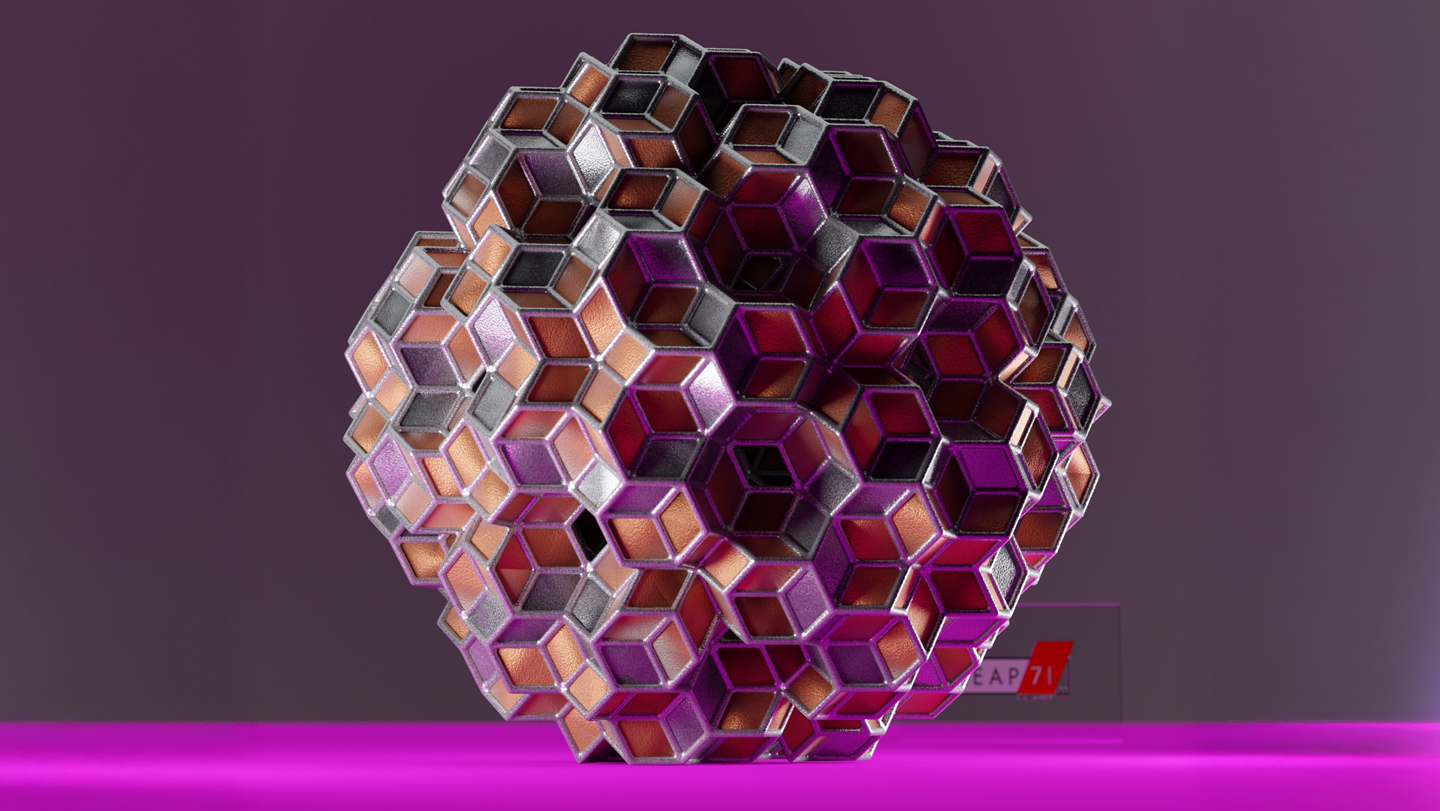
Physicists dream up ‘spacetime quasicrystals’ that could underpin the universe Skip to content Subscribe today Every print subscription comes with full digital access Subscribe Now Menu All Topics Health Humans Anthropology Health & Medicine Archaeology Psychology View All Life Animals Plants Ecosystems Paleontology Neuroscience Genetics Microbes View All Earth Agriculture Climate Oceans Environment View All Physics Materials Science Quantum Physics Particle Physics View All Space Astronomy Planetary Science Cosmology View All Magazine Menu All Stories Multimedia Reviews Puzzles Collections Educator Portal Century of Science Unsung characters Coronavirus Outbreak Newsletters Investors Lab About SN Explores Our Store SIGN IN Donate Home INDEPENDENT JOURNALISM SINCE 1921 SIGN IN Search Open search Close search Home INDEPENDENT JOURNALISM SINCE 1921 All Topics Earth Agriculture Climate Oceans Environment Humans Anthropology Health & Medicine Archaeology Psychology Life Animals Plants Ecosystems Paleontology Neuroscience Genetics Microbes Physics Materials Science Quantum Physics Particle Physics Space Astronomy Planetary Science Cosmology Tech Computing Artificial Intelligence Chemistry Math Science & Society All Topics Health Humans Humans Anthropology Health & Medicine Archaeology Psychology Recent posts in Humans Artificial Intelligence Real-world medical questions stump AI chatbots By Tina Hesman Saey6 hours ago Health & Medicine A simple shift in schedule could make cancer immunotherapy work better By Elie DolginFebruary 12, 2026 Health & Medicine This baby sling turns sunlight into treatment for newborn jaundice By Elie DolginFebruary 12, 2026 Life Life Animals Plants Ecosystems Paleontology Neuroscience Genetics Microbes Recent posts in Life Animals Some snakes lack the ‘hunger hormone.’ Experts are hungry to know why By Andrea Lius2 hours ago Oceans Evolution didn’t wait long after the dinosaurs died By Elie DolginFebruary 13, 2026 Animals A sea turtle boom may be hiding a population collapse By Melissa HobsonFebruary 13, 2026 Earth Earth Agriculture Climate Oceans Environment Recent posts in Earth Oceans Evolution didn’t wait long after the dinosaurs died By Elie DolginFebruary 13, 2026 Earth Earth’s core may hide dozens of oceans of hydrogen By Nikk OgasaFebruary 10, 2026 Animals Some dung beetles dig deep to keep their eggs cool By Elizabeth PennisiFebruary 4, 2026 Physics Physics Materials Science Quantum Physics Particle Physics Recent posts in Physics Physics Physicists dream up ‘spacetime quasicrystals’ that could underpin the universe By Emily Conover2 minutes ago Physics A precise proton measurement helps put a core theory of physics to the test By Emily ConoverFebruary 11, 2026 Physics The only U.S. particle collider shuts down – so a new one may rise By Emily ConoverFebruary 6, 2026 Space Space Astronomy Planetary Science Cosmology Recent posts in Space Astronomy This inside-out planetary system has astronomers scratching their heads By Adam MannFebruary 12, 2026 Space Artemis II is returning humans to the moon with science riding shotgun By Lisa GrossmanFebruary 4, 2026 Physics A Greek star catalog from the dawn of astronomy, revealed By Adam MannJanuary 30, 2026 News Physics Physicists dream up ‘spacetime quasicrystals’ that could underpin the universe Orderly structures that never repeat can exist in the melded space and time of Einstein’s relativity Conventional quasicrystals can exist in three spatial dimensions, as in the structure shown. But a quasicystal that inhabits spacetime is also a possibility. LinKayser/Wikimedia Commons (CC BY-SA 4.0) By Emily Conover 2 minutes ago Share this:Share Share via email (Opens in new window) Email Share on Facebook (Opens in new window) Facebook Share on Reddit (Opens in new window) Reddit Share on X (Opens in new window) X Print (Opens in new window) Print Mind-bending materials called quasicrystals have an orderly structure, but without a regularly repeating pattern. They’ve been found in meteorites and the debris from the first atomic bomb test. Scientists have now discovered that they can theoretically inhabit an even stranger realm: spacetime, the blended mixture of time and space of Einstein’s special theory of relativity. Instead of existing in two or three spatial dimensions, these quasicrystals’ structures would bridge space and time, physicists report in a paper submitted January 12 to arXiv.org. Although the quasicrystals are theoretical, the researchers suggest that such spacetime quasicrystals may appear in nature, perhaps even underlying the structure of the universe. Sign up for our newsletter We summarize the week's scientific breakthroughs every Thursday. A crystal is a structure that repeats itself. If you make a copy of a crystal, and slide it over on top of itself, you can find spots where the patterns match up perfectly. You can imagine doing the same with the tiles on your bathroom floor or the patterns on wallpaper. But quasicrystals, despite their seemingly orderly structure, don’t have such regular repetition. Crystals and quasicrystals are mathematical concepts that also appear in the real world, typically in materials with two or three dimensions. It wasn’t obvious that spacetime quasicrystals could exist. “My feeling was probably it wouldn’t be possible to make a proper spacetime quasicrystal,” says theoretical physicist Felix Flicker of the University of Bristol in England. But, he says, the researchers appear to have done just that. “The things they’ve come up with are … the most elegant things you can have in spacetime as a combined entity.” Despite quasicrystals’ lack of repetition, their orderliness means that their general characteristics are similar in different locations. An ant sitting atop one portion of a quasicrystal would see a structure similar to that seen by an ant in a different location. But different spacetime realms are another matter. Spacetime obeys a rule known as Lorentz symmetry. Lorentz symmetry means that something is unchanged whether you’re sitting still or moving at close to the speed of light. For example, the laws of physics respect Lorentz symmetry: They don’t change for fast moving observers. Lorentz symmetry doesn’t hold for previously known quasicrystals, or for normal crystals either: An ant sitting still would observe a different structure than would a near light-speed ant. In relativity, observers traveling at high speeds observe an apparent shortening of objects, and that distorts the materials’ structure. But the new spacetime quasicrystals obey Lorentz symmetry. They would appear the same to an ant sitting still as to one on a speeding rocket. The researchers mathematically formulated their quasicrystals by taking a four-dimensional slice through a grid of points in higher dimensions and projecting those points onto the slice. The slice has a slope that
Physicists dream up ‘spacetime quasicrystals’ that could underpin the universe