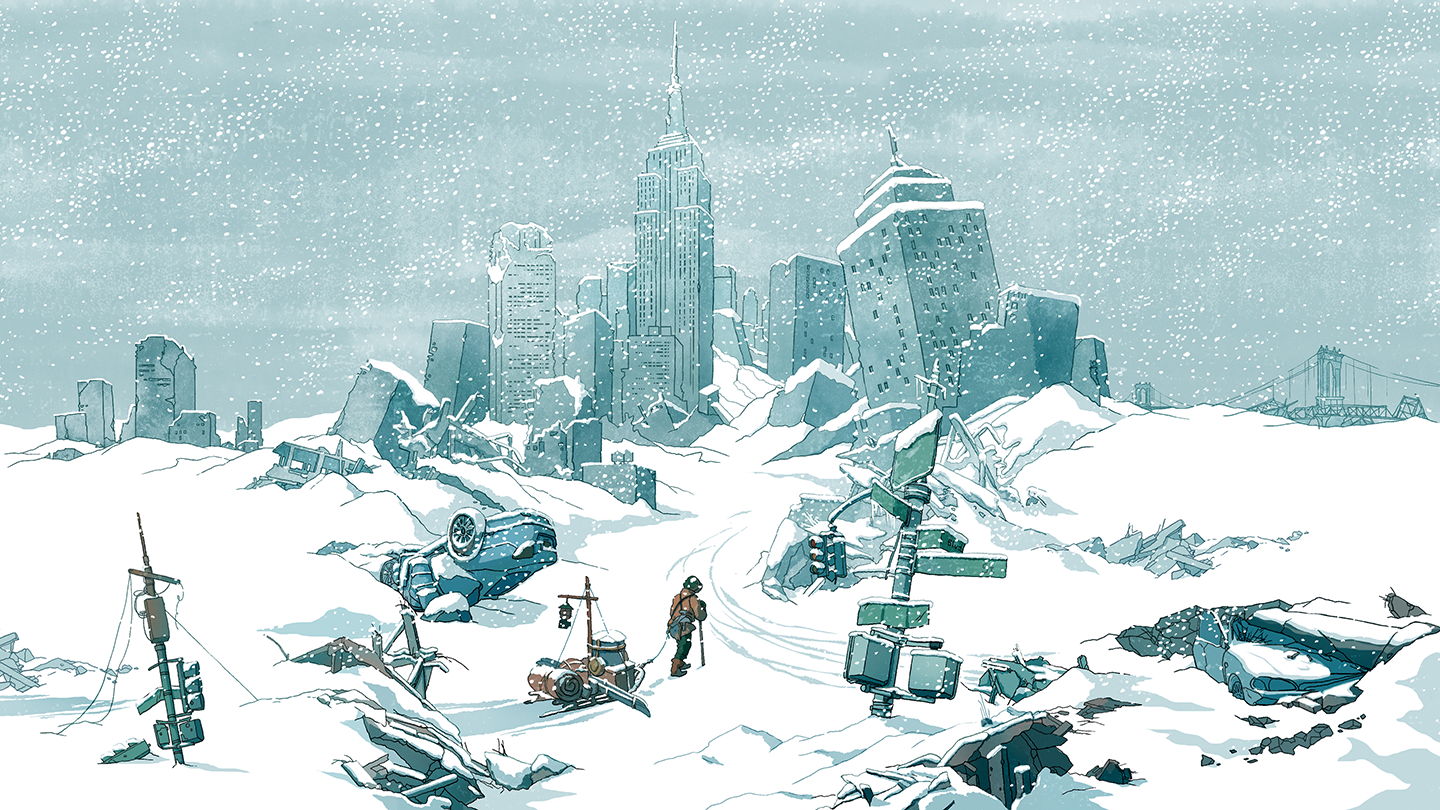
To make a ‘Snowball Earth,’ sci-fi moves fast. Geology is far slower Skip to content Subscribe today Every print subscription comes with full digital access Subscribe Now Menu All Topics Health Humans Anthropology Health & Medicine Archaeology Psychology View All Life Animals Plants Ecosystems Paleontology Neuroscience Genetics Microbes View All Earth Agriculture Climate Oceans Environment View All Physics Materials Science Quantum Physics Particle Physics View All Space Astronomy Planetary Science Cosmology View All Magazine Menu All Stories Multimedia Reviews Puzzles Collections Educator Portal Century of Science Unsung characters Coronavirus Outbreak Newsletters Investors Lab About SN Explores Our Store SIGN IN Donate Home INDEPENDENT JOURNALISM SINCE 1921 SIGN IN Search Open search Close search Home INDEPENDENT JOURNALISM SINCE 1921 All Topics Earth Agriculture Climate Oceans Environment Humans Anthropology Health & Medicine Archaeology Psychology Life Animals Plants Ecosystems Paleontology Neuroscience Genetics Microbes Physics Materials Science Quantum Physics Particle Physics Space Astronomy Planetary Science Cosmology Tech Computing Artificial Intelligence Chemistry Math Science & Society All Topics Health Humans Humans Anthropology Health & Medicine Archaeology Psychology Recent posts in Humans Health & Medicine Are pig organs the future of transplantation? By Meghan RosenMarch 17, 2026 Health & Medicine Smartwatch data can be used to assess early diabetes risk By Elie DolginMarch 16, 2026 Climate Extreme heat is cutting the time people can safely be active outdoors By Nikk OgasaMarch 16, 2026 Life Life Animals Plants Ecosystems Paleontology Neuroscience Genetics Microbes Recent posts in Life Microbes How warming is shifting microbial worlds By Erin Garcia de Jesús1 hour ago Animals Sharks are ingesting drugs in the Bahamas By Joshua Rapp LearnMarch 18, 2026 Animals Platypus fur has a surprising feature seen only in bird feathers By Jude ColemanMarch 17, 2026 Earth Earth Agriculture Climate Oceans Environment Recent posts in Earth Microbes How warming is shifting microbial worlds By Erin Garcia de Jesús1 hour ago Earth To make a ‘Snowball Earth,’ sci-fi moves fast. Geology is far slower By Carolyn Gramling24 hours ago Climate City skylines influence cloud formation above them By Larissa G. CapellaMarch 17, 2026 Physics Physics Materials Science Quantum Physics Particle Physics Recent posts in Physics Physics A static electricity mystery comes to the surface By Emily Conover22 hours ago Plants Tree tops sparkle with electricity during thunderstorms By Lily BurtonMarch 10, 2026 Physics When the pressure’s off, this superconductor appears to break records By Emily ConoverMarch 9, 2026 Space Space Astronomy Planetary Science Cosmology Recent posts in Space Space One possible recipe for life on Titan is a bust By Tina Hesman SaeyMarch 11, 2026 Astronomy A strange ‘chirp’ in a brilliant stellar blast points to a magnetar By Jay BennettMarch 11, 2026 Planetary Science NASA’s DART spacecraft changed an asteroid’s orbit around the sun By Lisa GrossmanMarch 6, 2026 Earth To make a ‘Snowball Earth,’ sci-fi moves fast. Geology is far slower Earth has frozen over before, climate history shows (looking at you, Cryogenian Period) Earth shook off its last ice age around 11,500 years ago, long before skyscrapers, cars and Brooklyn Bridges existed. Tung Nam By Carolyn Gramling 24 hours ago Share this:Share Share via email (Opens in new window) Email Share on Facebook (Opens in new window) Facebook Share on Reddit (Opens in new window) Reddit Share on X (Opens in new window) X Print (Opens in new window) Print Here are some ways the world might end in ice, according to science fiction. Earth freezes. Humankind’s remnants huddle in ice caves, fending off giant alien monsters (Snowball Earth). Or people shelter in the New York Public Library as ice encases the Empire State Building (The Day After Tomorrow). Or a train hurtles in an endless loop, both protection and prison for Earth’s scant survivors (Snowpiercer). These stories are all set in Earth’s near future, within a decade from now. And what makes the visions so chilling is that there’s a snowflake of truth in them. Well, space monsters haven’t invaded Earth — yet. And a lot of ink has been spilled describing the scientific fallacies of the movie The Day After Tomorrow. Sign up for our newsletter We summarize the week's scientific breakthroughs every Thursday. But there have been at least five ice ages in Earth’s history, the most severe one during the aptly named Cryogenian Period, between 720 million and 635 million years ago. At least twice during this period, glaciers extended from pole to pole, creating a “Snowball Earth.” Or “maybe it was more of a ‘Slushball Earth,’” says geoscientist Thomas Algeo of the University of Cincinnati. Fossils of seafloor-dwelling algae, which would have needed sunlight to survive, suggest that even in the coldest times, there were patches of open water near the equator that may have harbored life. Earth’s past deep freezes came from a combination of geologic processes. The Cryogenian followed after shifting tectonic plates caused a supercontinent to split apart. That increased rainfall and weathering, which dramatically reduced atmospheric carbon dioxide, causing runaway cooling. Widespread ice exacerbated the cooling, reflecting sunlight back to space rather than the ground absorbing the heat. These processes are slow, which is not ideal for dramatic storytelling. However, sci-fi has the advantage of playing with time, taking known natural — or human-caused — climate interactions and feedback effects and accelerating them or amping them up for drama. The Day After Tomorrow, for example, is based on a real-world scenario: the potential shutdown of the Atlantic Meridional Overturning Circulation, a part of a global system of ocean currents that transports heat around the world, keeping regions that might otherwise be frigid relatively warm. Geochemist Wallace Broecker suggested in the mid-1980s that large fluxes of freshwater to the North Atlantic Ocean could halt this circulation. Ocean current slowdowns or shutdowns have contributed to past ice ages, he said. Scientists fear it could happen again, and soon. But soon, geologically, means decades to a century. In The Day After Tomorrow, a new ice age arrives in weeks. Snowpiercer, a graphic novel, movie and TV series, imagines a different deep-freeze scenario: Geoengineering gone haywire. To mitigate global warming, scientists released aerosols into the atmosphere to reflect sunlight to space. The idea is based on an actual type of geoengineering known as solar radiation management. But the aerosols plunged the planet into a deep freeze within weeks (or hours, in the novel). Geoengineering strategies could cool Earth, but not that quickly (more like within
To make a ‘Snowball Earth,’ sci-fi moves fast. Geology is far slower