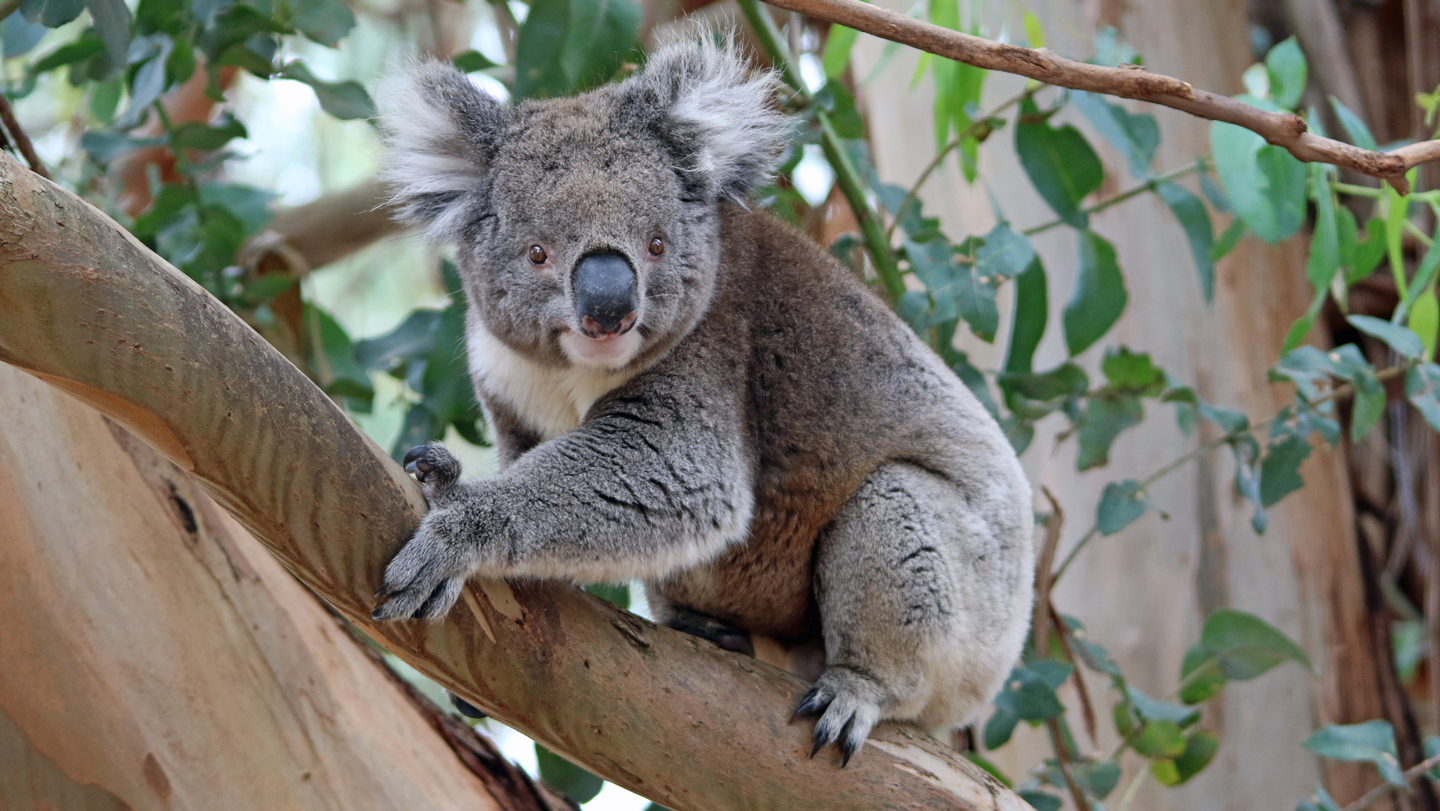
A koala population’s rapid rebound may let it escape inbreeding's perils Skip to content Subscribe today Every print subscription comes with full digital access Subscribe Now Menu All Topics Health Humans Anthropology Health & Medicine Archaeology Psychology View All Life Animals Plants Ecosystems Paleontology Neuroscience Genetics Microbes View All Earth Agriculture Climate Oceans Environment View All Physics Materials Science Quantum Physics Particle Physics View All Space Astronomy Planetary Science Cosmology View All Magazine Menu All Stories Multimedia Reviews Puzzles Collections Educator Portal Century of Science Unsung characters Coronavirus Outbreak Newsletters Investors Lab About SN Explores Our Store SIGN IN Donate Home INDEPENDENT JOURNALISM SINCE 1921 SIGN IN Search Open search Close search Home INDEPENDENT JOURNALISM SINCE 1921 All Topics Earth Agriculture Climate Oceans Environment Humans Anthropology Health & Medicine Archaeology Psychology Life Animals Plants Ecosystems Paleontology Neuroscience Genetics Microbes Physics Materials Science Quantum Physics Particle Physics Space Astronomy Planetary Science Cosmology Tech Computing Artificial Intelligence Chemistry Math Science & Society All Topics Health Humans Humans Anthropology Health & Medicine Archaeology Psychology Recent posts in Humans Neuroscience The right sounds may turn sleep into a problem-solving tool By Bethany BrookshireMarch 3, 2026 Health & Medicine Over 40? Your rotator cuff probably looks a little rough By Meghan RosenMarch 3, 2026 Health & Medicine Simulations of your gut may predict which probiotics will stick By Nora BradfordMarch 2, 2026 Life Life Animals Plants Ecosystems Paleontology Neuroscience Genetics Microbes Recent posts in Life Animals A koala population’s rapid rebound may let it escape inbreeding’s perils By Jake Buehler60 minutes ago Plants Chickpeas can grow in moon dirt and make seeds By Lisa Grossman5 hours ago Animals Cockroaches that eat each other’s wings turn into a fierce fighting force By Bethany BrookshireMarch 3, 2026 Earth Earth Agriculture Climate Oceans Environment Recent posts in Earth Climate Hundreds of studies have missed how much the oceans are rising By Nikk OgasaMarch 4, 2026 Climate Take it from the Olympics, slushy winter sports may be the new normal By Natasha VizcarraFebruary 27, 2026 Animals Climate change could threaten monarch mass migration By Erin Garcia de JesúsFebruary 25, 2026 Physics Physics Materials Science Quantum Physics Particle Physics Recent posts in Physics Chemistry This molecule puts a new twist on the Möbius strip By Emily Conover2 hours ago Physics Here’s why sneakers squeak on the basketball court By Emily ConoverFebruary 25, 2026 Animals Intricate silk helps net-casting spiders ensnare prey in webs By Emily ConoverFebruary 24, 2026 Space Space Astronomy Planetary Science Cosmology Recent posts in Space Plants Chickpeas can grow in moon dirt and make seeds By Lisa Grossman5 hours ago Planetary Science A Titan collision may link Saturn’s tilt, its moon Hyperion and its rings By Lisa GrossmanMarch 4, 2026 Planetary Science A chemical ‘Goldilocks zone’ may limit which planets can host life By Katherine KorneiMarch 4, 2026 News Animals A koala population’s rapid rebound may let it escape inbreeding’s perils The marsupials in southern Australia are showing signs of regaining genetic resilience Some koalas in Australia have rebounded their numbers from a small pool of individuals. Their genes are now catching up, restoring the genetic variation that was lost. mscaus/iNaturalist Australia By Jake Buehler 60 minutes ago Share this:Share Share via email (Opens in new window) Email Share on Facebook (Opens in new window) Facebook Share on Reddit (Opens in new window) Reddit Share on X (Opens in new window) X Print (Opens in new window) Print A rapid koala rebound in southeastern Australia is also boosting their genetic variation, showing one way out of an extinction death spiral. After nearly disappearing from the region over a century ago, the marsupials’ recovery has come with increased reshuffling of genes, enhancing their long-term chances of adaptation and survival. The findings, published March 5 in Science, provides hope for species starting over. By the early 1900s in the Australian state of Victoria, the number of koalas (Phascolarctos cinereus) had fallen to as few as 500 individuals due to pressure from the fur trade. To protect the larger Victorian population, people moved handfuls of them to nearby islands. The small island populations grew throughout the 20th century and so scientists moved some koalas back to the mainland to help bolster that much reduced population. Victoria’s koala population swelled to nearly half a million by 2020, but they were the descendants of small groups of forebears that lacked genetic diversity. Sign up for our newsletter We summarize the week's scientific breakthroughs every Thursday. These kinds of genetic bottlenecks in a species’ history may increase the risk of inbreeding and its negative effects. “That’s where you get deformities, poor health, things of that nature,” says Collin Ahrens, an evolutionary biologist at Cesar Australia, an independent environmental research company in Brunswick. Ahrens and his colleagues wanted to know how genomes had changed in koalas during this type of whiplash recovery. The team analyzed a database containing the genetic instruction books of 418 koalas from 27 populations across eastern Australia. It estimated the timing and degree of each population’s fall and rise in numbers, and how different measures of genetic variation had changed in response. Populations in Victoria showed the echo of their brush with extinction: Their genetic diversity was low. But that was just part of the story. As the population quickly grew and more mating occurred, it led to newer and varied genetic combinations along with new mutations, some of which can be beneficial. There still wasn’t much underlying variety in the genes compared with other populations. But the mixing and matching increased the changes that offspring could inherit beneficial genes without harmful ones. Already, tooth and testicle malformations have been reduced in the Victoria koalas, possibly from a change in the population’s genetic makeup. “All that genetic information is being mixed up in a lot of different new combinations,” says Ahrens. “In the north, we have a completely different picture.” There, koalas have higher genetic diversity, but they’re now entering a genetic bottleneck as their populations dwindle. In a way, the Victoria koalas’ genetic resurgence is like what’s sometimes found in invasive species. Such species rapidly balloon in numbers from a handful of individuals, similarly accumulating new mutations and variation as they interbreed. An example is the Roesel’s bush cri
A koala population’s rapid rebound may let it escape inbreeding’s perils