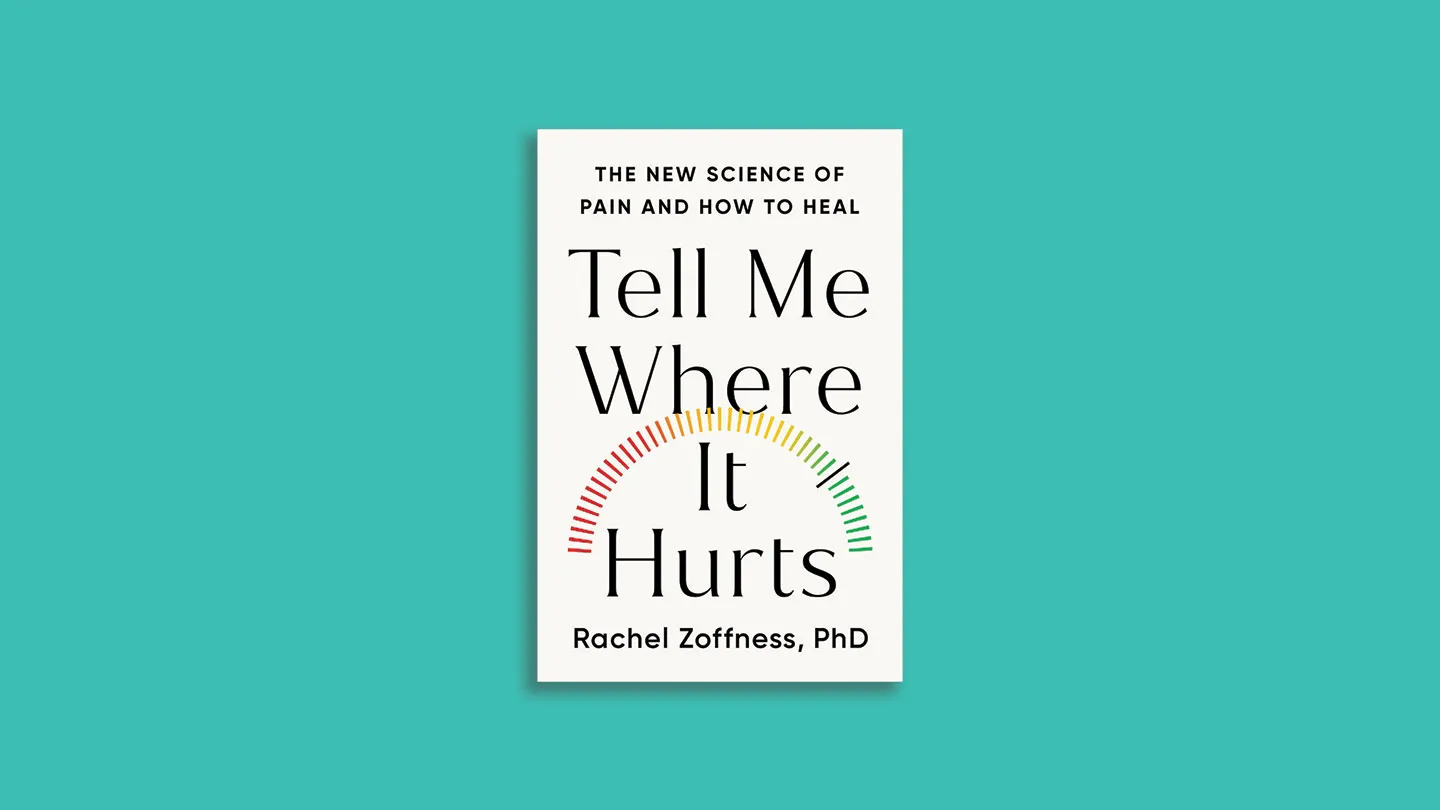
‘Tell Me Where It Hurts’ sets the record straight on pain — and how to treat it Skip to content Subscribe today Every print subscription comes with full digital access Subscribe Now Menu All Topics Health Humans Anthropology Health & Medicine Archaeology Psychology View All Life Animals Plants Ecosystems Paleontology Neuroscience Genetics Microbes View All Earth Agriculture Climate Oceans Environment View All Physics Materials Science Quantum Physics Particle Physics View All Space Astronomy Planetary Science Cosmology View All Magazine Menu All Stories Multimedia Reviews Puzzles Collections Educator Portal Century of Science Unsung characters Coronavirus Outbreak Newsletters Investors Lab About SN Explores Our Store SIGN IN Donate Home INDEPENDENT JOURNALISM SINCE 1921 SIGN IN Search Open search Close search Home INDEPENDENT JOURNALISM SINCE 1921 All Topics Earth Agriculture Climate Oceans Environment Humans Anthropology Health & Medicine Archaeology Psychology Life Animals Plants Ecosystems Paleontology Neuroscience Genetics Microbes Physics Materials Science Quantum Physics Particle Physics Space Astronomy Planetary Science Cosmology Tech Computing Artificial Intelligence Chemistry Math Science & Society All Topics Health Humans Humans Anthropology Health & Medicine Archaeology Psychology Recent posts in Humans Health & Medicine A simple shift in schedule could make cancer immunotherapy work better By Elie DolginFebruary 12, 2026 Health & Medicine This baby sling turns sunlight into treatment for newborn jaundice By Elie DolginFebruary 12, 2026 Health & Medicine Antibiotics can treat appendicitis for many patients, no surgery needed By Laura DattaroFebruary 10, 2026 Life Life Animals Plants Ecosystems Paleontology Neuroscience Genetics Microbes Recent posts in Life Oceans Evolution didn’t wait long after the dinosaurs died By Elie Dolgin2 hours ago Animals A sea turtle boom may be hiding a population collapse By Melissa Hobson4 hours ago Ecosystems Food chains in Caribbean coral reefs are getting shorter By Erin Garcia de JesúsFebruary 11, 2026 Earth Earth Agriculture Climate Oceans Environment Recent posts in Earth Oceans Evolution didn’t wait long after the dinosaurs died By Elie Dolgin2 hours ago Earth Earth’s core may hide dozens of oceans of hydrogen By Nikk OgasaFebruary 10, 2026 Animals Some dung beetles dig deep to keep their eggs cool By Elizabeth PennisiFebruary 4, 2026 Physics Physics Materials Science Quantum Physics Particle Physics Recent posts in Physics Physics A precise proton measurement helps put a core theory of physics to the test By Emily ConoverFebruary 11, 2026 Physics The only U.S. particle collider shuts down – so a new one may rise By Emily ConoverFebruary 6, 2026 Physics A Greek star catalog from the dawn of astronomy, revealed By Adam MannJanuary 30, 2026 Space Space Astronomy Planetary Science Cosmology Recent posts in Space Astronomy This inside-out planetary system has astronomers scratching their heads By Adam MannFebruary 12, 2026 Space Artemis II is returning humans to the moon with science riding shotgun By Lisa GrossmanFebruary 4, 2026 Physics A Greek star catalog from the dawn of astronomy, revealed By Adam MannJanuary 30, 2026 Reviews Health & Medicine Tell Me Where It Hurts sets the record straight on pain — and how to treat it The book helps readers understand the intricacies of pain, and points out ways to reduce it By Laura Sanders February 10, 2026 at 9:00 am Share this:Share Share via email (Opens in new window) Email Click to share on Facebook (Opens in new window) Facebook Click to share on Reddit (Opens in new window) Reddit Click to share on X (Opens in new window) X Click to print (Opens in new window) Print Listen to this article This is a human-written story voiced by AI. Got feedback? Take our survey . (See our AI policy here .) Tell Me Where It HurtsRachel ZoffnessGrand Central Publishing, $30.00 It’s a rare book that both expands an issue into a dizzyingly complex problem and offers to solve it. In Tell Me Where It Hurts, pain psychologist and scientist Rachel Zoffness pulls off both. Pain, she argues, has been deeply misunderstood. Sure, pain signals can come from damaged body parts. But that’s not the whole story. Through compelling patient stories and clear scientific descriptions, Zoffness leads readers to understand that pain is created by a complicated cocktail of elements, including emotions, trauma, beliefs and social ties. These ingredients can combine to form pain just as eggs, flour, butter and cocoa powder can coalesce into brownie batter. The pain recipe is one of Zoffness’ central metaphors that helps convey a variety of scientific explanations. It’s a simple approach, but it works. Sign up for our newsletter We summarize the week's scientific breakthroughs every Thursday. Consider the ingredient of expectations. To illustrate the power of beliefs in shaping pain, Zoffness tells us the tale of two nails. A young construction worker accidentally jumped off a plank and onto the first nail — a 7-incher. The nail’s sharp end was sticking up out of his boot, leaving him in anguish. He was rushed to an emergency department and given powerful medicine to ease his significant pain. When the boot finally came off, the sight was shocking: The nail had missed the man’s foot. “But despite the absence of injury, his pain was real,” Zoffness writes. The second nail came from a nail gun used by a different man. The gun misfired. As the man’s head slammed back, he saw a nail shoot out of the nail gun into the wall in front of him. Lucky break, or so he thought. Six days later, a toothache took him to the dentist, where x-rays revealed a 4-inch nail lodged in his face just a few ticks away from his right eye. “In this case, there was significant damage — but very little pain,” Zoffness writes. Together, these stories remind us of an easily overlooked truth: Pain is not an accurate indicator of bodily harm. Damaged body parts certainly can be painful but the other ingredients matter too. Pain is a biopsychosocial creation, Zoffness writes. “Our short-sighted focus on the bio alone means we’ve been missing two-thirds of the pain problem.” This expansive view of pain sounds grim — impossibly complex even. But Zoffness offers a salve. We can control some of the ingredients we use in our recipe. We can choose low-pain ingredients, and this book describes a lot of options. One section offers a menu of behavioral changes, broken down into specific, detailed plans for people in pain and their healthcare providers. For instance, “Never tell patients their pain is incurable,” she writes. While a disease may be incurable, a person’s pain may ebb. As scientific prose, this book threads a fine needle. The writing is swift and not overstuffed with technicalities. Still, Zoffness provides details in footnotes and citations for the
‘Tell Me Where It Hurts’ sets the record straight on pain — and how to treat it