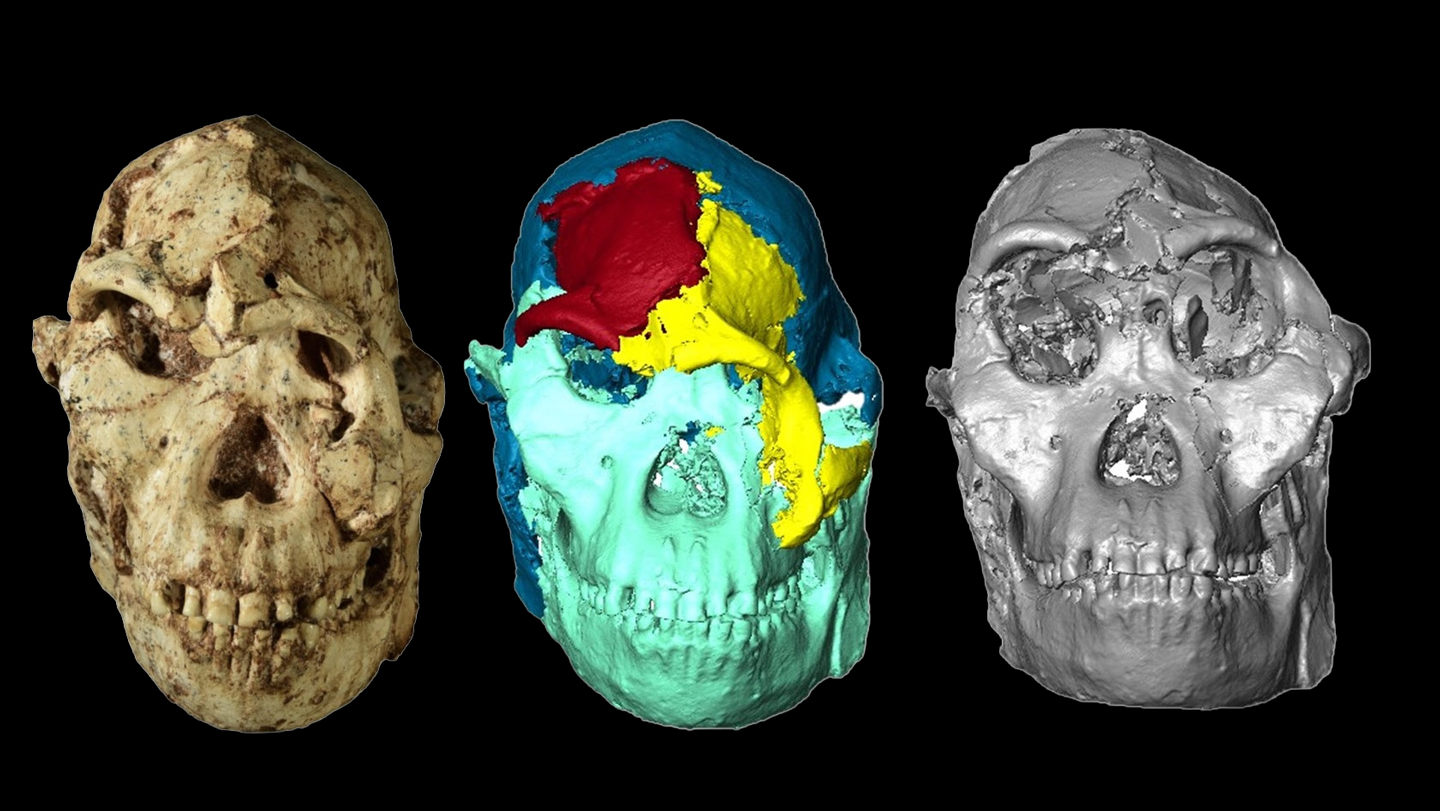
The ancient human ancestor ‘Little Foot’ gets a new face Skip to content Subscribe today Every print subscription comes with full digital access Subscribe Now Menu All Topics Health Humans Anthropology Health & Medicine Archaeology Psychology View All Life Animals Plants Ecosystems Paleontology Neuroscience Genetics Microbes View All Earth Agriculture Climate Oceans Environment View All Physics Materials Science Quantum Physics Particle Physics View All Space Astronomy Planetary Science Cosmology View All Magazine Menu All Stories Multimedia Reviews Puzzles Collections Educator Portal Century of Science Unsung characters Coronavirus Outbreak Newsletters Investors Lab About SN Explores Our Store SIGN IN Donate Home INDEPENDENT JOURNALISM SINCE 1921 SIGN IN Search Open search Close search Home INDEPENDENT JOURNALISM SINCE 1921 All Topics Earth Agriculture Climate Oceans Environment Humans Anthropology Health & Medicine Archaeology Psychology Life Animals Plants Ecosystems Paleontology Neuroscience Genetics Microbes Physics Materials Science Quantum Physics Particle Physics Space Astronomy Planetary Science Cosmology Tech Computing Artificial Intelligence Chemistry Math Science & Society All Topics Health Humans Humans Anthropology Health & Medicine Archaeology Psychology Recent posts in Humans Anthropology The ancient human ancestor ‘Little Foot’ gets a new face By Jay Bennett2 hours ago Neuroscience Why is math harder for some kids? Brain scans offer clues By Lily BurtonFebruary 27, 2026 Health & Medicine Can you trust the results from gut microbiome tests? Maybe not By Tina Hesman SaeyFebruary 26, 2026 Life Life Animals Plants Ecosystems Paleontology Neuroscience Genetics Microbes Recent posts in Life Anthropology The ancient human ancestor ‘Little Foot’ gets a new face By Jay Bennett2 hours ago Neuroscience Why is math harder for some kids? Brain scans offer clues By Lily BurtonFebruary 27, 2026 Animals Here’s how honeyeaters and other birds thrive on sugary diets By Bethany BrookshireFebruary 26, 2026 Earth Earth Agriculture Climate Oceans Environment Recent posts in Earth Climate Take it from the Olympics, slushy winter sports may be the new normal By Natasha VizcarraFebruary 27, 2026 Animals Climate change could threaten monarch mass migration By Erin Garcia de JesúsFebruary 25, 2026 Earth Metal pollution from a rocket reentry detected for the first time By Adam MannFebruary 25, 2026 Physics Physics Materials Science Quantum Physics Particle Physics Recent posts in Physics Physics Here’s why sneakers squeak on the basketball court By Emily ConoverFebruary 25, 2026 Animals Intricate silk helps net-casting spiders ensnare prey in webs By Emily ConoverFebruary 24, 2026 Physics Physicists dream up ‘spacetime quasicrystals’ that could underpin the universe By Emily ConoverFebruary 17, 2026 Space Space Astronomy Planetary Science Cosmology Recent posts in Space Space NASA scraps its 2027 moon landing, adds two missions in 2028 By Lisa GrossmanFebruary 27, 2026 Science & Society On moonshots and Minneapolis By Lisa GrossmanFebruary 27, 2026 Earth Metal pollution from a rocket reentry detected for the first time By Adam MannFebruary 25, 2026 News Anthropology The ancient human ancestor ‘Little Foot’ gets a new face High-resolution scans of a crushed skull reveal unexpected links to East African fossils The original skull (left), digital scan (middle) and reconstructed face of Little Foot offer a closer look at this enigmatic ancient human relative. Amélie Beaudet By Jay Bennett 2 hours ago Share this:Share Share via email (Opens in new window) Email Share on Facebook (Opens in new window) Facebook Share on Reddit (Opens in new window) Reddit Share on X (Opens in new window) X Print (Opens in new window) Print Scientists have finally come face-to-face with an ancient human ancestor called Little Foot. A new digital reconstruction reveals the visage of one of our oldest close human relatives, researchers report March 2 in the journal Comptes Rendus Palevol. The reconstruction offers a step toward better understanding human evolution. Little Foot is a member of the genus Australopithecus, an important ancestral group to our species’ own genus Homo. The skeleton’s small foot bones were first discovered in 1994 in a box of fossils at the University of the Witwatersrand in Johannesburg. The rest of the skeleton was found encased in rock in the Sterkfontein Caves, about 50 kilometers away, three years later. Sign up for our newsletter We summarize the week's scientific breakthroughs every Thursday. Some of the skeleton, including the skull and face, was partially crushed and distorted by the rock. In 2019, researchers scanned the skull using a synchrotron X-ray imaging facility in the United Kingdom to produce highly detailed models of the bones. They then spent years digitally putting Little Foot’s face back together. “Now we have a very good reconstruction, something we could not do with the physical specimen,” says paleoanthropologist Amélie Beaudet of CNRS in France. Beaudet and her colleagues compared the facial features of Little Foot with three other Australopithecus skulls and the features of related apes such as gorillas, chimpanzees and orangutans. Intriguingly, some of Little Foot’s features, such as distinctly wide eye sockets, appear more similar to fossils from East Africa than to those from South Africa where Little Foot was found. One possible explanation is that Little Foot represents a group of human ancestors who migrated from East Africa to South Africa more than 3.5 million years ago. This could help explain why Little Foot looks different from Australopithecus individuals who lived in the same area hundreds of thousands of years later. But Beaudet cautions that with so few Australopithecus skulls to compare, researchers cannot be sure that this is the reason for Little Foot’s unique looks. “We have only a few specimens, so we need to be really careful.” The next steps involve modeling Little Foot’s teeth and braincase, which will help scientists learn more about this enigmatic human relative and how it helped shape the evolution of the genus Homo, Beaudet says. “That’s the only way, I think, for us to understand … why we evolved the way we did.” Questions or comments on this article? E-mail us at feedback@sciencenews.org | Reprints FAQ Citations A. Beaudet et al. Virtual reconstruction and comparative study of the face of StW 573 (“Little Foot”). Comptes Rendus Palevol. Published March 2, 2026. doi: 10.5852/cr-palevol2026v25a3. R. Clarke et al. The skull of StW 573, a 3.67 Ma Australopithecus prometheus skeleton from Sterkfontein Caves, South Africa. Journal of Human Evolution. Published September 2019. doi: 10.1016/j.jhevol.2019.06.005. R. Clarke. Excavation, reconstruction and taphonomy of the StW 573 Australopithecus prometheus skeleton from Sterkfontein
The ancient human ancestor ‘Little Foot’ gets a new face