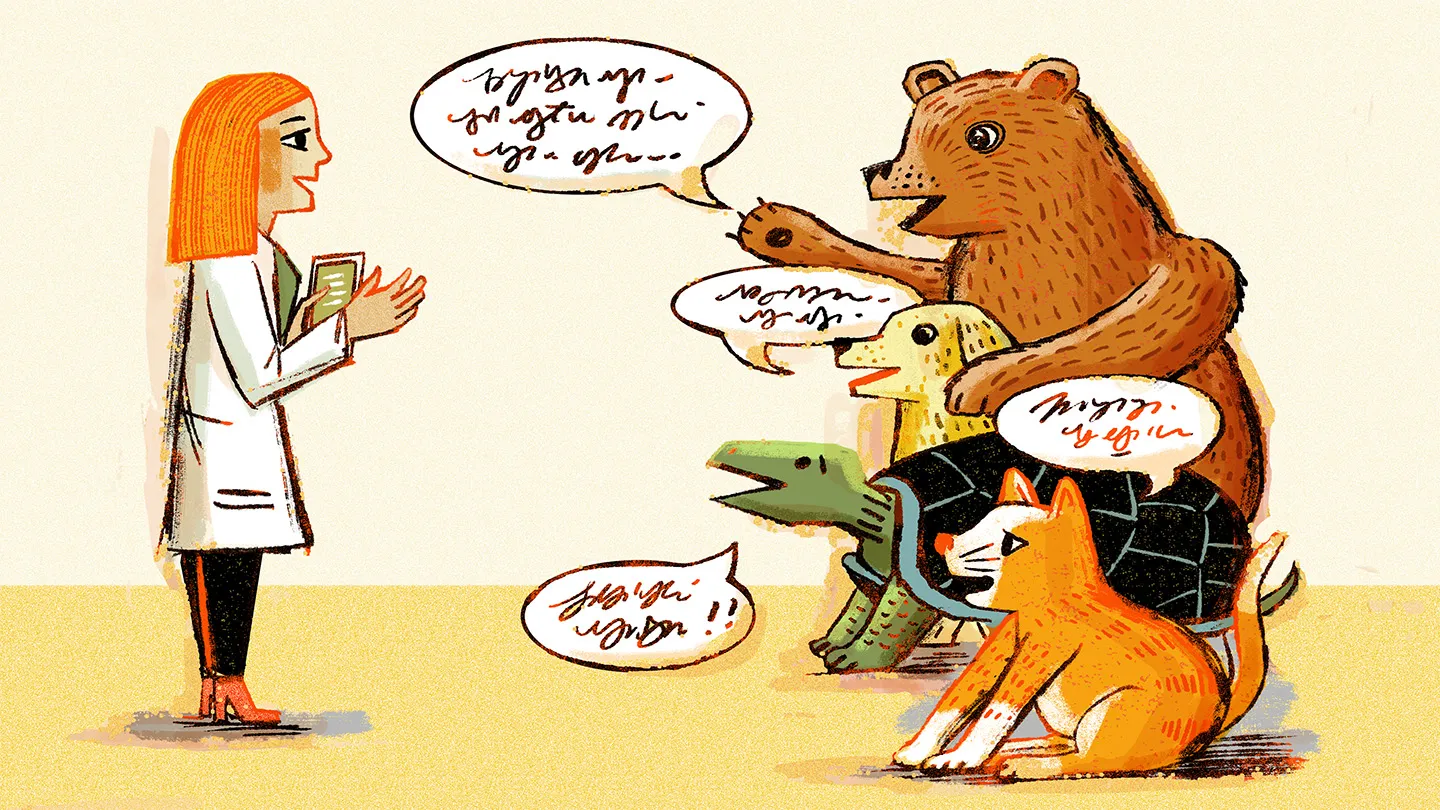
AI and tech advances may soon enable talking with animals Skip to content Subscribe today Every print subscription comes with full digital access Subscribe Now Menu All Topics Health Humans Anthropology Health & Medicine Archaeology Psychology View All Life Animals Plants Ecosystems Paleontology Neuroscience Genetics Microbes View All Earth Agriculture Climate Oceans Environment View All Physics Materials Science Quantum Physics Particle Physics View All Space Astronomy Planetary Science Cosmology View All Magazine Menu All Stories Multimedia Reviews Puzzles Collections Educator Portal Century of Science Unsung characters Coronavirus Outbreak Newsletters Investors Lab About SN Explores Our Store SIGN IN Donate Home INDEPENDENT JOURNALISM SINCE 1921 SIGN IN Search Open search Close search Home INDEPENDENT JOURNALISM SINCE 1921 All Topics Earth Agriculture Climate Oceans Environment Humans Anthropology Health & Medicine Archaeology Psychology Life Animals Plants Ecosystems Paleontology Neuroscience Genetics Microbes Physics Materials Science Quantum Physics Particle Physics Space Astronomy Planetary Science Cosmology Tech Computing Artificial Intelligence Chemistry Math Science & Society All Topics Health Humans Humans Anthropology Health & Medicine Archaeology Psychology Recent posts in Humans Health & Medicine New mutations help the H5N1 bird flu virus infect cows but not people By Tina Hesman Saey10 minutes ago Health & Medicine Fluoride in U.S. drinking water does not reduce IQ, a new study finds By Elie Dolgin21 hours ago Life Talking dogs and chatty cats could one day ‘speak’ in our language By Laura Sanders24 hours ago Life Life Animals Plants Ecosystems Paleontology Neuroscience Genetics Microbes Recent posts in Life Health & Medicine New mutations help the H5N1 bird flu virus infect cows but not people By Tina Hesman Saey10 minutes ago Life Smithsonian secrets most likely to blow your mind By Meghan Rosen and Stephen Voss2 hours ago Life Talking dogs and chatty cats could one day ‘speak’ in our language By Laura Sanders24 hours ago Earth Earth Agriculture Climate Oceans Environment Recent posts in Earth Animals For gray whales, San Francisco Bay is becoming a deadly pit stop By Gennaro TommaApril 13, 2026 Climate Emperor penguins are marching toward extinction. Antarctica fur seals too By Carolyn GramlingApril 9, 2026 Environment Hawaii is turning ocean plastic into roads to fight pollution By Sara NovakApril 8, 2026 Physics Physics Materials Science Quantum Physics Particle Physics Recent posts in Physics Cosmology Exploding black holes could explain an antimatter mystery By Emily ConoverApril 10, 2026 Quantum Physics Just 10,000 quantum bits might crack internet encryption schemes By Emily ConoverApril 1, 2026 Quantum Physics Quantum physics can confirm where someone is located By Emily ConoverMarch 30, 2026 Space Space Astronomy Planetary Science Cosmology Recent posts in Space Space Artemis II ends its historic lunar journey By Lisa GrossmanApril 10, 2026 Cosmology Exploding black holes could explain an antimatter mystery By Emily ConoverApril 10, 2026 Space Even before splashdown, Artemis II is delivering a scientific treasure trove By Lisa GrossmanApril 8, 2026 Life Talking dogs and chatty cats could one day ‘speak’ in our language Recent AI and other tech advances may soon enable chats with animals Imagine talking to — and understanding — other animals. Advances in decoding animal sounds might someday make that a possibility. ROBERT NEUBECKER By Laura Sanders 24 hours ago Share this:Share Share via email (Opens in new window) Email Share on Facebook (Opens in new window) Facebook Share on Reddit (Opens in new window) Reddit Share on X (Opens in new window) X Print (Opens in new window) Print Listen to this article This is a human-written story voiced by AI. Got feedback? Take our survey . (See our AI policy here .) In the animated movie Up, a boisterous dog wears an electronic collar that translates his doggy thoughts into English words. “My master made me this collar,” he tells his new acquaintances. “He is a good and smart master and he made me this collar so that I may talk — SQUIRREL!” In fiction, it’s a familiar piece of technology, a tool that can decode animals’ squeaks, meows, clicks and such into understandable human language. The sci-fi trope works in both directions. In the cartoon Rick and Morty, for instance, a translator lets Morty, a human boy, eavesdrop on squirrels that are running a worldwide cabal of crime. Their fast, cute little voices talk about coup d’états, overthrowing the world order and chemtrails. Sign up for our newsletter We summarize the week's scientific breakthroughs every Thursday. Back here in the nonfiction world, anyone with a pet has probably wondered at one point or another what’s going on in that inscrutable little head. Scientists can’t say. But there are some reasons to think that devices that decode animal sounds into language that humans can understand won’t be works of science fiction forever. Advances in computing power, artificial intelligence and ways to measure sounds promise to speed this translating process, turning animal chatter into bits of information that could be decoded by humans. Of course, some animals can already talk to us — in our preferred languages, too. Neuroscientist Erich Jarvis tells a story of a parrot that left its California home. It returned years later speaking Spanish, says Jarvis, of the Rockefeller University in New York City. Those sorts of language skills are rare. The mental skills and physiological flexibility needed to think up a message and make intricate vocal sounds to convey it are traits present in fewer than 1 percent of vertebrate species, says New York University neuroscientist Michael Long. And with rare exception, none really speak our language. But that gap is not insurmountable. “Animals are speaking — to use speaking in a very loose way — more vibrantly than we had ever given them credit for,” Long says. Dolphins and whales, like parrots, may make good conversation partners with people. In 2023, scientists were able to use a decoded whale “hello” to enjoy a short chat with an Alaskan humpback. It wasn’t exactly scintillating; the exchange consisted of a volley of whale whups, translated as “hello” in English. Still, it was an interspecies chat. Another group of researchers has since discovered that whale language shares statistical properties with those spoken by humans. With these sorts of advances, perhaps we’ll soon be swapping krill recipes. Some of Jarvis’ research includes mice genetically engineered to produce more complex sounds. He and colleagues are scrutinizing key genes that are active in good vocal learners. Mice with a human version of a protein called NOVA1, for instance, made more complex vocalizations. To be clear, this isn’t a talking
Talking dogs and chatty cats could one day ‘speak’ in our language